
EIS manifesto
49. Council and South Lanarkshire Local Association
“That this Annual General Meeting commends the EIS Scottish Parliament Election Manifesto in how it has set out our policy aims, including the ongoing Stand Up for Quality Education campaign. Furthermore, AGM welcomes the IPPR Report, which sets out how EIS may implement the five key policies for schools set out in the Manifesto within a costed, affordable timeline.
AGM commends the work already carried out in pursuit of these aims, but further resolves to:
- Seek regular formal engagement with COSLA and Scottish Government on these priorities.
- Continue national coordination and pursuit of the EIS Manifesto policies;
- Raise the profile of the EIS manifesto call to reinstate early years teachers by undertaking a campaign of publicity, including highlighting to parents and the media the current situation of early years teacher erosion.
- Lobby the government and local authorities, making the case for early years teachers as essential to delivering the CIC successfully;
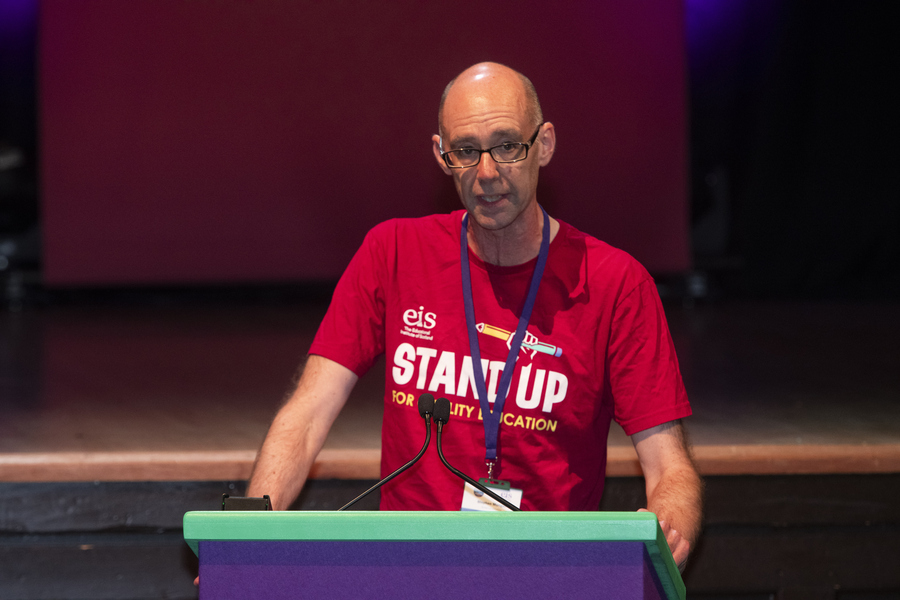
- Sustain, develop and continue to organise members for the Stand Up for Quality Education campaign as a continued strategic programme of work;
- Provide practical guidance and resources to support branches in campaigning in all strands of the campaign and relevant key manifesto policies;
- Continue to encourage and facilitate Local Associations and Branches to campaign to increase teacher numbers, and to undertake targeted campaigns and disputes where teacher numbers or other education cuts are proposed;
Incoming EIS President Mark Smith (Council and North Ayrshire) successfully moved a motion calling for continued national coordination and pursuit of the EIS Manifesto policies. Mr Smith stated, “The EIS manifesto outlines a long-term vision for schools to reduce class sizes to 20 pupils and restore the number of GTCS registered teachers to 2012 levels. We must continue to fight for the best education system.”
Seconding the motion, Stephen Mungall (South Lanarkshire) said, “Early years teachers are highly qualified practitioners with expertise, yet despite their importance we are seeing their numbers continually diluted by local authorities. We cannot build a world class education system based on a rocky foundation.”
Tackling bureaucracy
50. East Dunbartonshire Local Association and Dumfries & Galloway Local Association
That this AGM notes the increasing administrative and bureaucratic demands placed on teachers, including data collection, tracking systems, and reporting requirements; and the increased non-teaching workload placed on teachers in promoted posts.
This AGM recognises the impact of these demands on teacher workload and the time available for teaching and learning.
This AGM instructs Council to:
- campaign for a reduction in unnecessary bureaucracy and to promote recognition of teachers’ professional judgement in assessment and reporting;
- Give increased emphasis within EIS campaigning to reducing unnecessary bureaucracy and non-teaching workload placed on teachers in promoted posts; and
- Campaign for enforceable measures to protect teaching and leadership time, reduce administrative burden, and improve retention in promoted posts.
James McIntyre (East Dunbartonshire) moved a motion noting the increasing administrative and bureaucratic demands placed on teachers. “Being dedicated to your profession should never cost you your health, your wellbeing or your relationships. Many members feel there is now a culture in education where no initiative is ever allowed to stop. Increasingly, our members feel they are being crushed under structures that are designed to measure absolutely everything, rather than do the job.”
Speaking in support of the motion, Amanda Murray (Aberdeen City) said, “The issue is we need this to be a living, breathing reality. We know the tasks that are taking up our day.” The motion was passed unanimously.
Number of teacher posts
51. South Lanarkshire Local Association
That this AGM reaffirms the EIS commitment to increasing the number of teacher posts and recognises that additional GTCS registration in secondary subjects could play a part in addressing specific shortages. Accordingly, AGM calls on Council to campaign for central and local government to support and fund interested registered teachers to become additionally qualified and GTCS registered.
Amendment Inverclyde Local Association
Replace ‘increasing’ with ‘campaign for an increase in’
Insert ‘permanent’ between ‘of’ and ‘teacher’.
This Motion reaffirmed the need to increase the number of teacher posts. Jennifer Gaffney (South Lanarkshire) successfully moved the motion, noting that, “This is not a problem of teachers not having adequate qualification. It is the responsibility of the system to invest in its workforce. In a context of growing workload pressure, we must trust in teachers as skilled professionals.”
Nicolas Boisson (South Lanarkshire) spoke in support of the motion, “Solidarity to the many passionate and brilliant teachers who are walking away from the profession, because they simply cannot afford to live in precarity. It is a time of the unknown.” The motion was carried.
Alternatives to exclusion
52. North Lanarkshire Local Association
That this AGM calls on Scottish Government to provide local authorities with additional ringfenced funding for more alternatives to exclusions to meet the needs of learners, especially those who are care experienced, and ensure adequate training is provided to staff.
Amendment Midlothian Local Association
After ‘care experienced’ insert ‘or have an additional support need’.
Daniel Henderson (North Lanarkshire) moved this motion. He explained that young people within the care system cannot be sent home under exclusion guidance. This results in many young people remaining in schools that do not have capacity to support them fully when they are dysregulated. He presented this motion to the AGM as he believes there must be alternatives to exclusion available for young people in care, including trauma informed specialist support.
Stuart Winning (North Lanarkshire), seconded this motion, calling for tenanted exclusion to be available for pupils growing up in care. He asked AGM to support this motion, as budgets become further squeezed, a commitment is needed to fund this alternative to exclusion, and also to fund the additional resources needed for staff training. This motion was passed.
Increased funding for ASN
53. North Lanarkshire Local Association and Dumfries & Galloway Local Association
That this AGM notes the ongoing increase in the number of pupils identified with Additional Support Needs (ASN) in Scottish schools, and notes that staffing, specialist support, and resources have not kept pace with this increase.
That this AGM calls on the Scottish Government to increase funding for ASN provision, and instructs Council to campaign for increased national investment in ASN provision, including more ASN teachers and support staff, and to press the Scottish Government and COSLA to address the gap between ASN needs and current resourcing.
Elspeth Green (North Lanarkshire) proposed this motion. She said that most of Scotland’s ASN pupils are educated within mainstream classes and “without adequate resources it is pushing both pupils and teachers beyond their reasonable limits.” She explained to the AGM that the level of need within Scotland’s schools is continuing to rise with record numbers of pupils struggling with communication, emotional regulation or with complex medical needs and the resourcing must catch up with these pupil needs.
Julie Irving (Dumfries & Galloway) seconded this motion and stated that, “If the Cabinet Secretary for Education is serious about raising attainment, then we must fund Additional Support Needs appropriately.” She said that whilst many Headteachers are being creative with how PEF money is being used, more funding is needed to support all pupils.
Amanda Murray (Aberdeen City) also supported this motion calling for more resourcing to be put into teacher education to support the training of more ASN teachers. The motion passed.
Training and guidance against violent incidents
54. South Lanarkshire Local Association and Dumfries & Galloway Local Association
That this AGM notes with concern the rise in violent incidents and distressed behaviour in schools.
This AGM recognises the serious impact these incidents have on teacher wellbeing, staff retention, and the safe running of classrooms. This AGM instructs Council to campaign for stronger national guidance and protections for teachers, including consistent recording and reporting of incidents, and greater support for members affected by workplace violence.
That this AGM calls on Council to lobby local authorities to provide more training for teachers in de-escalation strategies to help in behaviour management, and more staffing to ensure the education of the whole class is not negatively impacted.
Amendment Midlothian Local Association
Remove ‘more training for teachers in de-escalation strategies to help in behaviour management and’.
Kirsten Holman (South Lanarkshire) proposed this motion to the AGM. She highlighted EIS research which found that 80% of schools face violent and aggressive incidents on a weekly basis. “This same EIS survey data also found that teachers working in these schools do not feel supported.” She highlighted that as an ASN teacher she is used to dealing with dysregulated pupils, but that her working environment is designed to better support these pupils. “Far too many pupils are being placed in mainstream environments that aren’t appropriate for them, which is further exacerbating their dysregulation.” She continued by saying that far too many teachers are being asked to support pupils without the adequate training, resourcing or wider school support. She highlighted that this issue has been presented to the EIS AGM for many years and ended by saying, “Shouldn’t this be the last year that we have someone standing up here talking about violent incidents?” This motion was passed unanimously.
Investment in school buildings
55. East Dunbarthonshire Local Association
That this AGM instructs Council to:
- Intensify and strengthen EIS campaigning on the condition and upkeep of school buildings; and
- Campaign for sustained national and local investment in school buildings as an essential component of high-quality education.
Amendment EIS ULA
(point a; first sentence) – after “school”, insert “, college and university”.
(point b; first sentence) – after “school”, insert “, college and university”.
This motion was presented by James McIntyre (East Dunbartonshire) who explained to the EIS AGM the state of the buildings that he and his colleagues are expected to teach in. “We have to deal with leaks, concerns around electrical safety, broken fire doors and there are areas of the school that staff can’t go into because it’s not safe – the list of problems goes on and on.” He told the AGM that too often, staff are expected to work around these problems to the extent that it’s becoming normalised to teach with buckets in the room to collect water from leaks.
Emily Connon (East Dunbartonshire), in seconding the motion, explained that, “We’re dealing with genuine structural neglect in Lenzie Academy. Going into work is becoming a daily battle against the elements.”
Kyra Tweddle (Scottish Borders) in support of the motion told the AGM that in her school she has maggots raining down into her classroom. Instead of fixing the problem, she has been told by her employers that she is to work around it as it only happens for a couple of weeks twice a year.
Heather Hughes (West Lothian) also supported this motion and highlighted that West Lothian Council has been identified as the worst affected by RAAC building practices. She said that one of the biggest secondaries in the region was half demolished to remove the RAAC at a cost of £32 million and counting. She also mentioned that whilst the Scottish Government had promised to cover the costs of making these buildings safe, financial support has yet to materialise.
Contributions in support of this motion were also heard from Julie Chrystal (Fife), Derek Smith (FELA), John Allison (FELA), Paula McEwan (Inverclyde) and Sylvia Mercer (Shetland). This motion was passed unanimously.
Specialist Principal Teachers
56. Glasgow Local Association
That this AGM, as part of the current workload campaign, reaffirm its position that every subject should be led by a subject specialist PT and actively campaign for their reintroduction at every opportunity.
William Insch (Glasgow) proposed this motion, seconded by Des Kenny (Glasgow). They explained that since the introduction of faculties across many local authorities it has removed subject specific knowledge from departments. With the introduction of faculty heads some departments are now being managed by someone with no knowledge of the subjects under their remit. William Insch asked the AGM to support the motion by asking, “Do faculties actually raise attainment? I wouldn’t say so.” He also raised the ongoing issues around unsustainable workload for many faculty heads. This motion was passed.
Political Education
57. Council
That this Annual General Meeting notes the challenging political context in Scotland and internationally.
AGM acknowledges the historic struggle between capital and labour, and that many of the laws, public services and contractual terms that are in place today were won by workers in the past.
AGM recognises the potential of political education, innovatively structured, in strengthening members’ collective understanding of trade unionism, democratic processes, and the economics and the political landscape in our society which directly and indirectly impact education and employment, and how trade unions, including the EIS, are a force for good in the struggle for a better, fairer, more just society.
AGM therefore resolves to develop and implement an innovative national political education strategy that aims to bring members together for a variety of multi-modal learning opportunities, both nationally and locally.
Mark Smith (Incoming President) proposed this motion to AGM, on behalf of EIS Council. He explained that trade unions have always been a force for good and that the EIS is proudly included in that history. He told the AGM that illegal wars are being fought and at home there is a rise in the far right – we are also still living through austerity measures. “The decisions taken by politicians have a significant impact in our schools.”
Allan Crosbie (Council & Edinburgh) seconded this motion and explained, “The latest research reveals that young people are increasingly being targeted by bad actors on social media.” Many young people are turning away from mainstream, regulated media and are increasingly being exposed to extreme content that radicalises them. It is becoming an increasingly dangerous landscape for teachers who are also having to raise the alarm on radicalised parents.
Sean McNamara (North Lanarkshire) supported the motion and gave an example in his school when he was challenged by a parent for displaying an anti-racism poster in his classroom because their child identified as a racist.
Contributions in support of this motion were also received from Bill Ramsay (South Lanarkshire) and Eleni Papagiannaki (ULA). This motion was passed.
X (formally Twitter)
58. Glasgow Local Association
That this AGM instructs the national body of the EIS to stop using the social media platform X (formerly Twitter).
This motion was withdrawn.
Open Source IT
59. Edinburgh Local Association
That this Annual General Meeting call upon the EIS to investigate and report on the feasibility, advantages, and disadvantages of moving from Microsoft as its chosen IT platform to open-source alternatives.
Amendment Council
Delete ‘the EIS’ and replace with ‘Council’.
Phil Pearce (Edinburgh), successfully called for the EIS to investigate moving to open-source IT platforms.
Moving the motion, Mr Pearce said, “The world’s largest software provider is running a monopoly, forcing us to continue using software that we are essentially renting. The idea of digital sovereignty allows organisations like ours to use software, free of the influence of these global giants. Open source would reduce our dependency, and restore our ownership of our systems. Many local authorities and government bodies across Europe have moved to open source.”
Seconding the motion, Craig Duffy (Edinburgh) highlighted that the world’s largest software provider is amongst those on the Boycott, Divestment, and Sanctions (BDS) list of companies that have provided support for illegal actions by the Israeli state against Palestine. “I don’t know if it is feasible for us to move to open source, but we need to at least explore the possibility,” he said. The motion was passed.
Employment Rights Act
60. Renfrewshire Local Association and Dundee Local Association
That this AGM instructs Council to:
- arrange national training as soon as is practically possible for all Local Association Secretaries on the subject of the Employment Rights Act, 2025, including changes to industrial relations and employment rights and to disseminate this information to School Reps and Local Activists;
- distribute guidance to Local Associations on any implications that the Employment Rights Act, 2025, may have for devolved matters and LNCT local agreements.
Amendment EIS FELA
Point 2. add “and Branch Secretaries” after LA Secs. And also in point a. delete ‘School’ before Reps.
David Gibson (Dundee) was successful in a call for the EIS to provide guidance and training to local associations on the Employment Rights Act (2025).
“This is one of the most significant changes in employment law for many years. It is a pretty big deal. We really need training on the details, so that we can offer accurate guidance to school reps, activists and members,” said Mr Gibson.
Seconding the motion, Margaret Russell (Renfrewshire) said, “It is vital that there is awareness of all the implications of the act for LA Secretaries, Reps and activists. We need bespoke training from lawyers or the EIS legal department.” AGM delegates agreed, and voted to pass the motion.
Cultural New Deal
61. South Lanarkshire Local Association
That this AGM calls on Council to: collaborate with the STUC and arts-based trade unions to call on the Scottish Government to create and deliver a “Cultural New Deal” that reverses the decline in the working class art workforce and which prioritises increased working class-representation in the creative industries, by articulating and delivering a funded strategy and pathway to support working class people to develop their artistic skills in school and then into any post-school destinations, including college, university and work.
Steven Mungall (South Lanarkshire) delivered a passionate speech, in which he convinced AGM to work with the STUC and arts-based unions to call for a cultural new deal. “Our society is unwell, we have been sleepwalking into a two-tier system. An achievement gap is stripping our young people of their fundamental right to self-expression. The arts form a huge part of our society, but where are the next artists coming from? We can’t leave the arts solely in the hands of the affluent – let’s protect the arts for the many, not just the few,” said Mr Mungall.
The Motion was seconded by Joe Smyth (South Lanarkshire) who said, “As teachers, we know the importance of representation. The creative industries should reflect the diversity of the communities that they serve.” The motion was passed.
Case handling systems
62. Edinburgh Local Assocation
That this Annual General Meeting instruct Council to investigate and report on the efficacy of the case handling databases and member engagement tools used by a range of other unions, this range to be defined by the Executive Committee.
The EIS will investigate the efficacy of bespoke case-handling systems as the result of a successful Motion proposed by Alison Murphy (Edinburgh). “Speaking to colleagues in other unions, they have a specially designed case-handling system, specifically designed for that purpose. We should have a discussion with other unions, possibly through STUC and TUC, to see if there is a better way to manage our casework,” said Ms Murphy.
School starting age
63. Argyll & Bute Local Association
That this Annual General Meeting calls on Council to commission independent research into Scotland’s current school starting age and its impact in both primary and secondary sectors.
The EIS will commission independent research into Scotland’s school starting age, following a successful motion proposed by Aisling Clark (Argyll & Bute) who said, “Around one-third of children now defer starting school, with age gaps of up to 19 months within the same cohort. Yet we continue to organise learning around the assumption that we are dealing with a single group.”
Seconding the motion, Joanne Kelly (Argyll & Bute) added, “This idea is already picking up momentum politically and within pressure groups, so the EIS needs to take the lead on commissioning good quality independent research into this issue.”
Speaking in support, Education Convener Susan Quinn said, “Deferments are increasingly being used because of a lack of required specialist support, meaning that we have young people requiring additional support coming into our schools with almost a 2-year age gap.”
EIS affiliations
64. Edinburgh Local Association
That this Annual General Meeting resolve to investigate and report on the suitability of the following as organisations to which the EIS should affiliate and/or donate:
- White Ribbon Scotland;
- The Lemkin Institute for Genocide Prevention and Human Security;
- The Hands Up Project;
- Love Music Hate Racism.
Amendment EIS ULA
Add point “5. Trade Unions in Communities”.
The EIS will investigate and report on the suitability of five diverse peace and equality organisations for EIS affiliation or funding support, following a motion proposed by Tom MacColl (Edinburgh) who said, “Scotland should not be a small-minded, inward-looking country but an outward looking, globalist country.”
The motion was seconded by Jehan Al-Azzawi (Edinburgh) who said, “At a time when Palestinian Children are facing systematic destruction of their education, these types of EIS affiliations are extremely important.”
BDS movement
65. Edinburgh Local Association
That this Annual General Meeting resolve to invite Omar Barghouti, co-founder of the Boycott, Divestment and Sanctions (BDS) movement for Palestinian rights and co-recipient of the 2017 Gandhi Peace Award, to address one of the EIS Council meetings in session 2026-7, in person or online, depending on his availability, on the subject of the Boycott, Divestment and Sanctions (BDS) movement for Palestinian rights and his views on the effectiveness of this movement.
The EIS will extend an invitation to Omar Barghouti, co-founder of the BDS movement for Palestinian Rights, to address a meeting of EIS Council, following a successful motion proposed by Tom Colquhoun (Edinburgh), who said, “There is no moral obligation to trade with states supporting genocide – quite the opposite.”
The motion was formally seconded by Jehan Al-Azzawi (Edinburgh).
Sounding a note of caution was Andrew Porter (Aberdeenshire), who said, “Please be careful about the impact on the Jewish community of our actions.”
Equality Convener Nicola Fisher said, “Our brother at the opposition microphone was right – we must not equate Judaism with Zionism or with Israel. But, equally, we also must not equate support for Palestine with antisemitism.”
And Alison Murphy (Edinburgh) added, “We in the EIS absolutely condemn antisemitism, just as we condemn anti-Islamic actions.” Following a vote, the motion passed overwhelmingly.
Palestine Mission to the United Kingdom
66. Edinburgh Local Association
That this Annual General Meeting resolve to invite Dr Husam Zomlot, Head of The Palestine Mission To The United Kingdom, to address the EIS AGM in June 2027, in person or online, depending on his availability, on the subject of the state of education and of the wellbeing of pupils, students, teachers and lecturers, in all educational sectors, within the Occupied Palestinian Territories of the West Bank, East Jerusalem and the Gaza Strip.
The EIS will invite Dr Husan Zomlot, Head of the Palestine Mission to the United Kingdom, to address next year’s AGM, following a successful motion proposed by Tom Colquhoun (Edinburgh), who said, “This motion would invite Dr Husam to address us directly on the direct impact of Israel’s actions in Palestine.” The motion was seconded by Jehan Al-Azzawi (Edinburgh).
Ukraine Solidarity Affiliation
67. Dumfries & Galloway Local Association
That this AGM resolves that EIS will affiliate to the Ukraine Solidarity Campaign Scotland.
Tracey Trayner (Dumfries & Galloway) moved this motion. She explained the aims of the Ukraine Solidarity Campaign in Scotland, supporting the Ukrainian community in Scotland. She praised the solidarity work already undertaken by the EIS through affiliations, with the belief that the EIS can condemn Russia’s crimes just as the EIS condemns the crimes committed by Israel.
She spoke on the work already being undertaken by other affiliated trade unions and ended with a plea to delegates to support the motion, “To enable our members to begin to create that solidarity with Ukrainian workers we must start with affiliation.”
Andrew Porter (Aberdeenshire) seconded the motion, he noted the sense of unity displayed at conference over the last few days, hoping that this can carry across to the motion on affiliation to the USCS. “I hope that the expressions of solidarity heard over the course of conference would lead to a reciprocation of solidarity by members for this motion.”
Tom Colquhoun (Edinburgh) was first to the podium on the other side of the hall. Speaking against the motion he noted that he and the wider membership absolutely should condemn Russia’s continued aggression against Ukraine but that he must oppose the motion due to the USCS’s aim of defending Ukraine’s independence and territorial integrity, by any means they deem necessary.
The wording of this aim was the issue for many delegates who spoke against the motion with Paula McEwan (Inverclyde) noting that the line ‘by any means necessary’ is in direct conflict with the EIS’s calls for peaceful negotiation. After more speakers for and against, the motion ultimately fell.
Affiliation to the Calton Weavers
68. Glasgow Local Association
That this AGM agrees to affiliate to the Calton Weavers Commemoration Committee.
Neil Anderson (Glasgow) moved the motion on affiliation to the Calton Weavers Commemoration Committee. He gave a brief history lesson on The Calton Weavers, six workers who were shot dead for instigating Scotland’s first strike. The first ever martyrs of industrial action in Scotland.
“I want the EIS to affiliate to help fund this work and commemorate the birth of the Labour movement in Scotland”.
The motion was formally seconded by Andrew Fullwood.
Craig Duffy (Edinburgh) raised concerns in speaking against the motion. He suggested that a lot of people may not have heard of the commemoration committee. “I don’t feel I have enough information to know if the EIS should or should not affiliate to this organisation”.
Delegates called for a remittal to council after hearing the concerns raised by members on the opposing podium.
Increased visibility of the far right
69. Council
That this Annual General Meeting recognises and is concerned by the increased visibility of far-right narratives within public discourse and their impact on education settings, including among children and young people, parents, teachers, school staff, lecturers and wider communities.
This AGM condemns the efforts of the far-right to target schools for their political advantage and to influence the curriculum to aid far-right narratives.
AGM commends the work already undertaken by the Institute and some local authorities, such as Glasgow City Council, to counter the influence of far-right narratives on Scotland’s education settings.
AGM therefore resolves to:
- Instruct the EIS to provide further advice and support to members and Local Associations in countering far-right narratives in and around educational establishments;
- Update our existing guidance for members on identifying, challenging, and safely responding to far-right activity affecting schools, colleges and local communities;
- Inform members of the anti-worker policies of far-right parties;
- Continue to produce educational materials and provide learning opportunities to support members in promoting anti-racist, antihomophobic, anti-transphobic, inclusive and democratic values in educational settings;
- Train workplace representatives and officers on countering far-right narratives and organising collectively in response;
- Work with partner organisations to strengthen collective opposition to far-right influence in education and wider society.
Amendment 1 EIS FELA
In first bullet point add “and Self-Governing Associations” after ‘Local Associations’.
Amendment 2 Fife Local Association
Last bullet point after ‘with’ insert ‘ affiliates and’.
The final motion of conference was moved by Nicola Fisher on behalf of Council, the increased visibility of far right narratives and the impact of this on the school and wider community. Ms Fisher’s position was clear, “The far right are a clear and present danger to the children in our care who we educate. They are a clear and present danger to all marginalised communities and our society.”
In seconding the motion Nuzhat Uthmani (Council) warned delegates not to stay silent in the face of rising hate. That even in their own classrooms the far right is becoming mainstream and the challenge has already arrived to tackle this rise. “Silence is not safety. Silence is a signal to the children being targeted in our classrooms that we will not stand with them.”
Further support for the motion came from Irvine Tait (Shetland) who asked delegates to think about the reason behind the prevalence of the far right, noting that a lack of public sector growth coupled with tax cuts for the rich undermining support for the poor have contributed to far right narratives gaining this foot hold in society. The motion was carried by delegates, concluding this year’s formal AGM business.