16 days of action on gender based violence is an annual international campaign to end violence against women and girls
Gender-based violence is unfortunately an issue that continues to affect our school communities. According to the End Violence Against Women Coalition (EVAW) research carried out in 2023, nearly one-third of girls don’t feel safe from sexual harassment in school.
And with women making up a significant majority of the teaching profession and the EIS 2023 survey reporting violent and aggressive incidents in schools every week in over 80% of branches, the impact on the health, safety and wellbeing of women workers cannot be ignored.
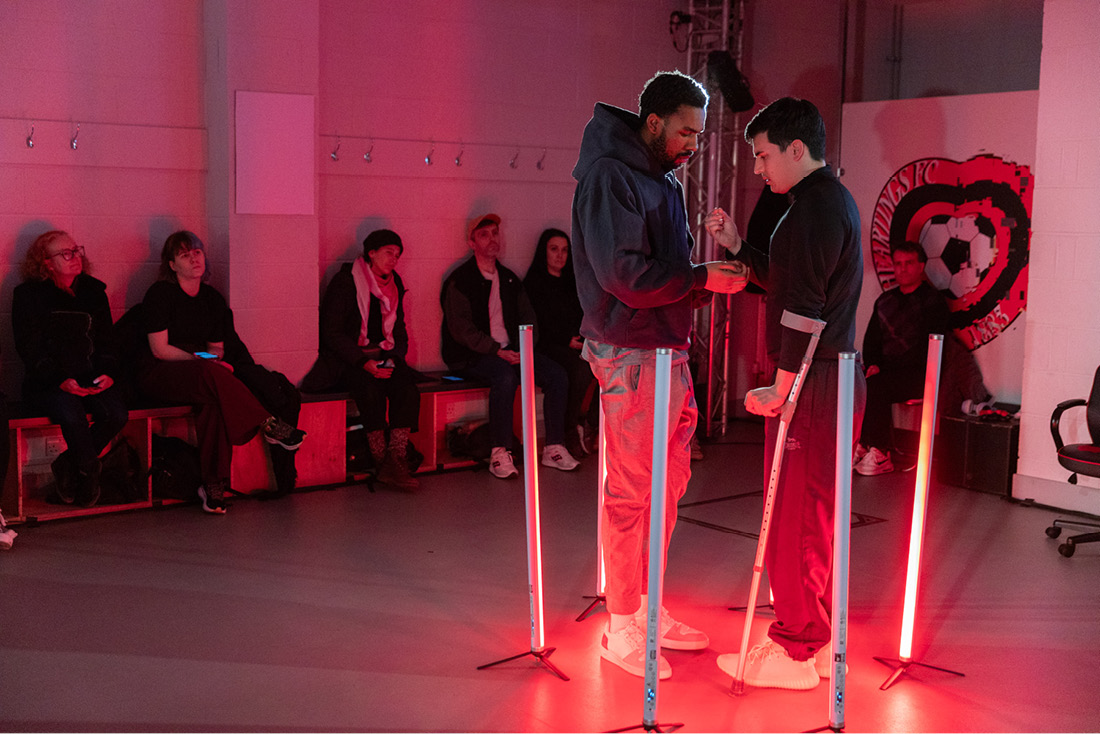
The EIS is currently working with participatory theatre and learning company Civic Digits to develop a teaching resource on misogyny, drawn from the ‘Many Good Men’ project which saw co-created plays developed with young people.
Many Good Men follows the dual stories of friends Derek and Leo, and Stirling and George. The characters are all young/amateur football players who witness a misogynistic attack in broad daylight. The event changes their lives forever and although their lives take different paths, all the characters’ beliefs about themselves and about their future are deeply challenged.
In both stories the two pairs of friends start a campaign against online misogyny, and struggle privately with their mental health. The characters end up becoming influenced themselves by what they are seeing online, in different ways, with significant consequences for their wellbeing and relationships.
The resource will offer guidance and activities for members to engage young people in the characters of ‘Many Good Men’, to consider what influence online prejudice might have on someone who is vulnerable, and what they can do to build their resilience against harmful influences, empowering young people to imagine how they can be part of changing the tide on issues they themselves may be affected by. The resource will launch in January 2026.
In the meantime, here are ten facts and six actions that members can take to learn more about, to challenge, and to take action against gender-based violence.
10 Facts
1) Gender-based violence is a cause and consequence of women’s inequality. The prevalence of misogynistic attitudes and behaviours in our society enable a context where gender-based violence is possible. Ultimately gender-based violence is about power and control.
2) 51% of EIS branches in 2023 reported that boys were more likely to exhibit violent and aggressive behaviours towards women teachers than men teachers. Almost 40% of branches stated that prejudice-based violence had increased between 2019 and 2023.
3) In 2025, 68% of girls between 11-21 in a UK survey reported having changed their everyday behaviour to avoid sexual harassment, with 1 in 10 girls having missed school to avoid sexual harassment. (Girl’s Attitudes Survey 2025)
4) Domestic abuse is a gender equality issue as the vast majority of those experiencing domestic abuse are women and the vast majority of those perpetrating domestic abuse, are men. Domestic abuse is never okay, whoever you are. (Scottish Women’s Aid)
5) Recent research has found that men and masculinity influencers are increasingly gaining a mainstream following, with nearly two-thirds of young men aged 16-25 in UK watching this content online (Movember, 2025).
6) Statistics show that 1 in 3 women worldwide have experienced either physical and/or sexual violence in their lifetime. Most of this violence is perpetrated by an intimate partner. (Rape Crisis Scotland)
7) The Scottish Crime and Justice Survey (2019) found than 0.8% of men and 6.2% of women in Scotland have experienced at least one type of serious sexual assault since the age of 16.
8) In 2025, disabled girls, neurodivergent girls and LGBT+ girls reported being more likely to have received comments that make them feel scared for their safety. Black, Asian or Minority Ethnic girls reported being less likely to share photos of their face online, or go outside when it’s dark, due to safety concerns (Girl’s Attitudes Survey 2025)
9) Boys and men are also negatively impacted by gender stereotypes and gender-based pressures, for example to be strong, successful and heterosexual. Such pressures can adversely impact mental health and wellbeing.
10) According to a briefing by Education Scotland and Scottish Women’s Aid, at least one child in every class will have experience of domestic abuse. This can have an impact on attendance and on the ability to focus on learning in class. Support provided must be approached with sensitivity and care.
6 Actions you can take now
- Organise in your local association / branch to mark 16 days of activism and raise the profile of anti-GBV work, for example through committing to sign up to Equally Safe at School (for Secondary settings)
- Watch four short videos with experts on GBV, considering how educators can make a difference,
- Teach about activism to end domestic abuse – for example using the ‘Speaking Out Learning Resource’, which explores the history of the Women’s Aid movement and how activism led to the development of a service to support women, children and young people, experiencing domestic abuse, and to huge changes in how society and the law now view and understand domestic abuse.
- Negotiate for your establishment to adopt the recommendations contained within the Scottish Government Whole School Framework on Preventing and Responding to Gender Based Violence and consider how this can be taken forward to support the health and safety of members, for example through implementing Equally Safe at School, a whole school approach that enables schools to continually build and reinforce messages that challenge violence and promote gender equality.
- Read Zero Tolerance’s report on Young Scots’ experiences of online misogynistic extremism and radicalisation ‘Many Good Men’
- Learn about tools and strategic resources for schools to counter the effects of online hate, disinformation and prejudice at www.digitaldiscourse.scot
If you are concerned about a child, please follow your establishment’s child protection protocol.
If you are worried about yourself or someone you work with, you can contact: Scotland’s Domestic abuse and Forced Marriage 24-hour helpline: 0800 027 1234
Rape Crisis Scotland Helpline: 0808 801 0302