
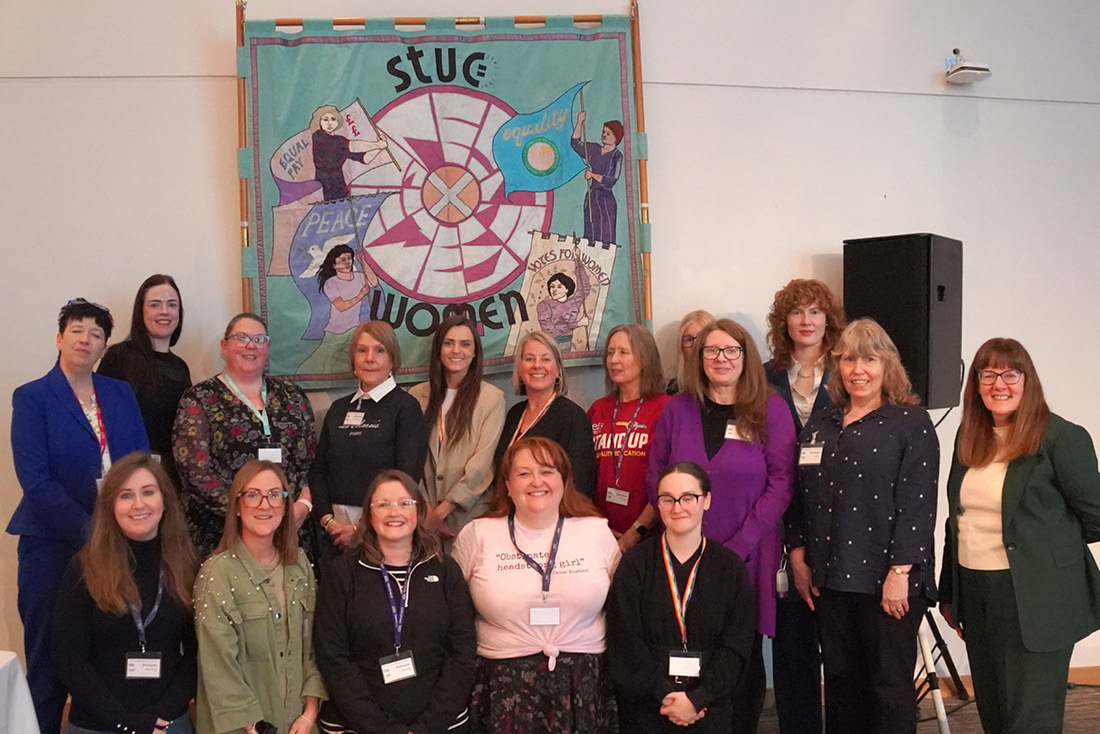
The 98th STUC Women’s Conference was chaired by Pearl Abernethy of Community Union. In her Chair’s address, Pearl highlighted the ongoing organising and campaigning around women’s rights led by the STUC Women’s Committee.
She spoke about the importance of working collectively as women within the trade union movement and opened the conference with a message of solidarity, “Solidarity is our greatest strength.”
Intersectional solidarity remained a cornerstone of this year’s conference — from the theme Women Build Bridges, Not Borders to the motions considered by delegates.
EIS member and first-time delegate Carmen Sullivan moved the first of the EIS motions, Motion 9: Critical literacy skills and political literacy as resilience against far-right influence. Carmen cited EIS statistics from the national branch survey, evidencing the rise in prejudice-based violence and aggression, particularly among male pupils and often directed at women teachers.
She told conference how this increase in misogyny has been accelerated in the digital age, “Misogyny is supercharged by social media,” and “far-right narratives are now piped straight into our pupils’ pockets.”
The motion called on the STUC Women’s Committee to support the wider STUC work in countering the far-right. It also urges the STUC to engage with Time for Inclusive Education, including their digital resource, the Digital Discourse Initiative, which Carmen described as vital for teachers. The motion passed unanimously.
EIS delegates then spoke in support of a range of other motions on women’s safety, equality, women’s health, and maternity pay, before Claire Robertson moved the second EIS motion of the conference.
Motion 27: Addressing prejudice-based violence through intersectional solidarity, calls on the Women’s Committee to liaise with the STUC Disabled Workers’ Committee, the STUC Black Workers’ Committee, the STUC Youth Committee, and the LGBT+ Workers’ Committee.
Conference agreed that an intersectional approach is essential when tackling discrimination, as an attack on one group can quickly become an attack on all. Claire encapsulated this in her speech stating, “When rights and freedoms are being questioned for some groups of people, these rights and freedoms will sooner or later be compromised for the presumably privileged ‘majority’ as well.”
The conference closed with a renewed commitment to collective action, and affirmed that intersectional solidarity is not just a slogan but a strategy. A strategy that EIS members in particular and the trade union movement as a whole will continue to advance.