
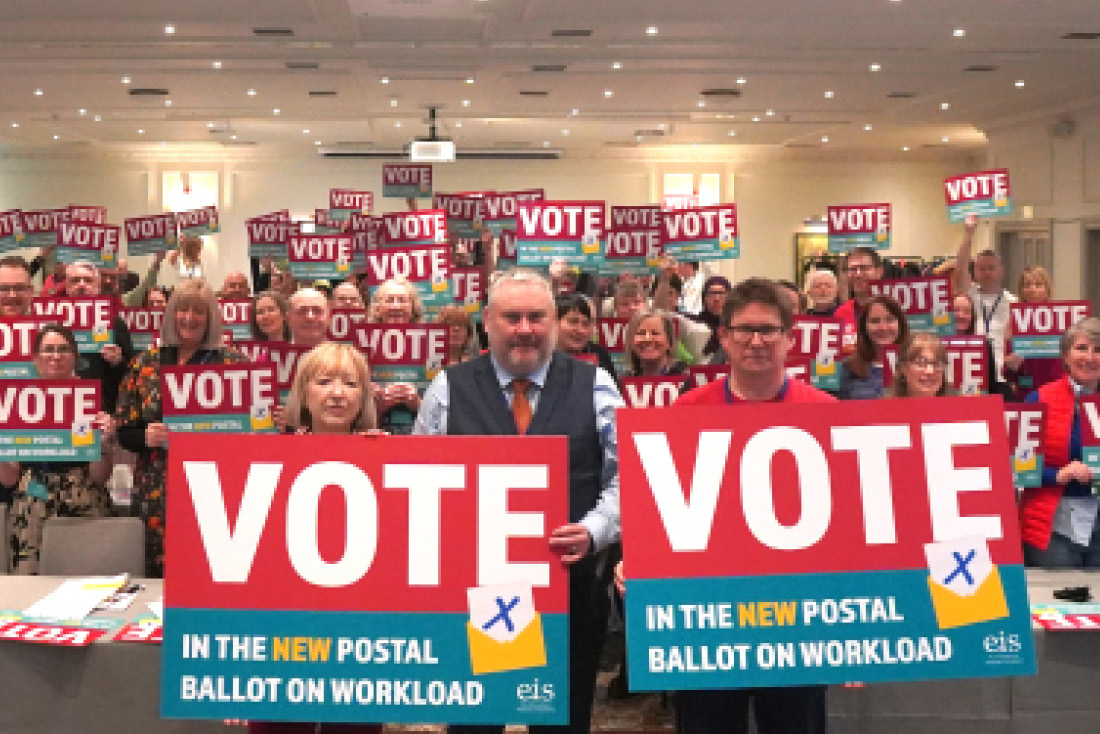
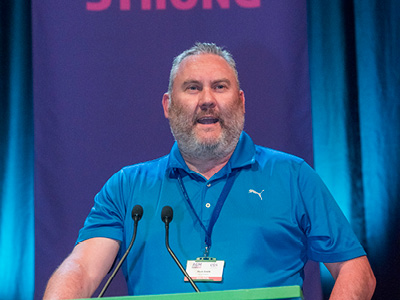
Vice-President Mark Smith, delivering the report of the Executive Committee, provided an overview of campaign activity related to the recent statutory ballot, outlining the wide range of activities in the promotion of participation of the ballot.
There had been, he said, a structured campaign to encourage people to vote including all member emails, EIS Engage analysis, branch visits, targeted emails, campaign videos, a campaign hub on the EIS website, SMS blasts, peer to peer SMS, social media, and national and local webinars.
There had also been two weeks of phone banking, with members being called to encourage them to vote.
“In the end, the ballot result was, of course, disappointing in that we narrowly missed the threshold on turnout, despite strong levels of support for industrial action,” said Mr Smith.
Mr Smith went on to outline discussions at the special meeting of the Executive Committee that followed the ballot result. He said that, after much discussion on the advantages and disadvantages of various options, the committee decided to conduct an immediate re-ballot in order to facilitate industrial action.
The proposed timeline was also discussed of opening the ballot in early February and closing in early March with a view to potentially carrying out industrial action in mid-March before Parliament dissolves on March 27th.
“Re-balloting keeps the pressure on government,” said Mr Smith, “and, following discussion, there was overwhelming support for moving ahead with a re-ballot.”
Heather Hughes (West Lothian) asked if data would be available from the EIS’s electoral service as to the number of replacement ballot papers that had been requested, and the number issued. Mr Smith said that this information was being sought to inform the new ballot process.
Graham Keir (Fife) asked what steps might be taken to secure a higher turnout in the new statutory ballot. The Vice-President replied that the special meeting of Executive and a recent meeting of Local Association Secretaries had considered these issues, and that a range of steps – including further cleansing of the ballot database and additional steps to ensure that all member address data was up to date – were being enacted, and that all possible steps would continue to be reviewed throughout the ballot period.
Education Committee
Convener Susan Quinn updated Council on the work of the Committee. On Education Reform, Ms Quinn told Council that the Committee had received a presentation from Scottish Government officials on the implementation of the Education (Scotland) Act 2025, focusing on the transition from the SQA to Qualifications Scotland and the creation of the new office of HM Chief Inspector of Education.
Committee members asked a number of probing questions, in relation to how the voices of teachers and lecturers would influence decision-making and governance in the new national agencies and highlighted concerns about the delay in appointing a HM Chief Inspector of Education and the associated impact of this on delivering meaningful change.
Employment Relations Committee
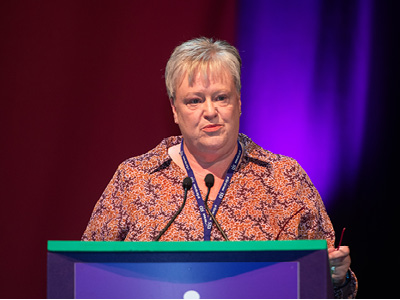
Convener Susan Slater said that the Committee had welcomed donations from 4 local associations, Argyll & Bute, Dumfries & Galloway, East Lothian and Scottish Borders.
There was also a donation from EIS Financial Services. The Committee agreed to increase the threshold for benevolent fund applications from £10,000 per adult and £5,000 per child to £12,000 per adult and £6,000 per child.
On applications for assistance, Ms Slater said that 32 applications were considered and grants totalling £84,000 were authorised by the Committee.
Moving onto legal affairs, Ms Slater told Council that the Committee had considered 26 cases and noted that settlements totalling £79,755 had been secured on behalf of 5 members.
Equality Committee
Convener Nicola Fisher, joining the meeting remotely, updated Council on the work of the Committee. On cross-cutting issues, Ms Fisher said that plans for the Our Voices in Union Weekend School 2026 continue apace.
The first day will include leadership and equality learning, and the second day will provide an overview of EIS equality strategy and related work and give attendees the opportunity to draft motions and campaigns in a number of equality areas.
Ms Fisher also advised Council that Committee members had reviewed video scripts that will form the basis of the Disrupting Disinformation project, which aims to engage members in anti-far right material and activity through examples of evidence-based social dialogue. This is funded through the United Workplaces Fund from the STUC.
Salaries Committee
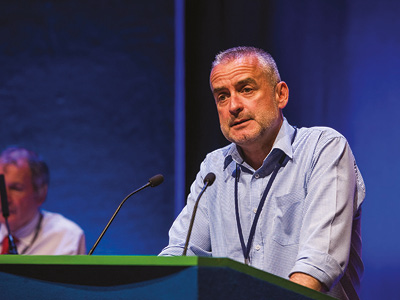
Convener Des Morris confirmed to Council that, at a meeting of SNCT Extended Joint Chairs in December, agreement has been reached on the terms of a reopener clause in respect of the second year of the recently agreed pay settlement.
The clause provides pay protection to teachers, in that it allows for the re-opening of discussions on the year 2 pay settlement, should inflation rise above an agreed level. An SNCT circular providing full details of the terms of the re-opener was scheduled to be issued, said Mr Morris.
On the reduction of Class Contact Time, Mr Morris told Council that the Scottish Government had been unable, at the meeting of the SNCT RCCT Working Group of 3 December 2025, to provide tangible detail on the proposals contained in its paper sent to the Teachers’ Side on 20 November.
Mr Morris highlighted that the Teacher’s Panel, on 16 December, had issued a statement reiterating that resolution of the current dispute requires, firstly, agreement on all sides that the full amount of time resulting from the reduction in weekly class contact time be allocated to teachers’ ‘preparation and correction’ time to address unsustainable workload.
Motions
Three Motions were discussed and passed by Council: Agreement to donate £10,000 to educational charity Scottish Development Education Centre (Allan Crosbie, Edinburgh); Endorsement of STUC and EI statements in relation to Venezuela and other actions to show support for the people of Venezuela (Jehan Al Azzawi, Edinburgh & Andrew Fullwood, Glasgow); Support for the right to protest as a fundamental democratic principle (Andrew Fullwood, Glasgow).
Frank Healy
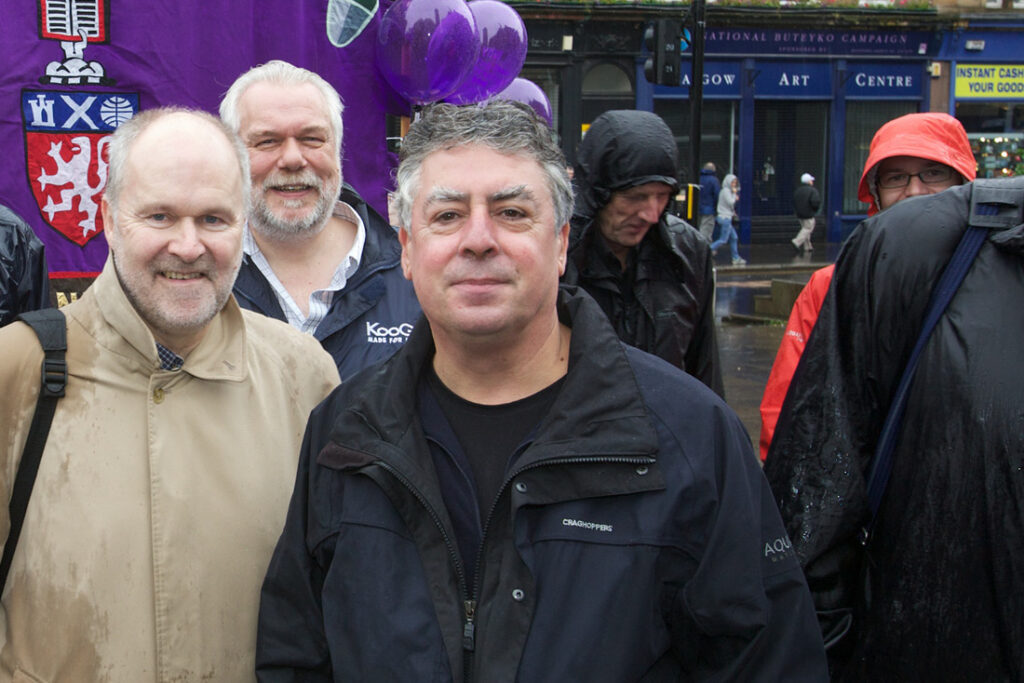
The recent meeting of EIS Council paused for a moment of reflection to remember EIS activist and former staff member Frank Healy, who passed away on the 19th of January 2026 following a long battle with cancer.
Frank was a long-time activist and Rep with the EIS before serving as LA Secretary in East Dunbartonshire and latterly as the EIS Area Officer in Glasgow.
Frank retired from the EIS in 2017 but continued to fight and campaign for workers’ rights and he remained committed to the trade union movement. He also was an ever-present face at rallies and marches over the years within the Labour movement in Scotland.
He was a lovely man, who always made himself available to help others. He will be remembered for his integrity, his kindness and his unwavering devotion to advocacy. A credit to the trade union movement.