

EIS President Adam Sutcliffe reports on a recent solidarity visit to Canada.
Last October I was delighted to be invited by the CSQ (la Centrale des Syndicats du Québec) to attend their General Council and take part in an international round table with trade union activists from Portugal and Italy.
The CSQ is the third largest trade union in Québec representing support staff, healthcare workers and childcare employees amongst other categories.
As this invitation fell during my two-week October break I was able to get in some tourism around the beautiful Gaspé peninsula, including the breathtaking Percé UNESCO Global Geopark. I’m glad I did this part of the trip first as it allowed me to attune my ear to the Québecois French, which initially sounds very different to the French I am used to speaking and hearing (I am a fluent French speaker).
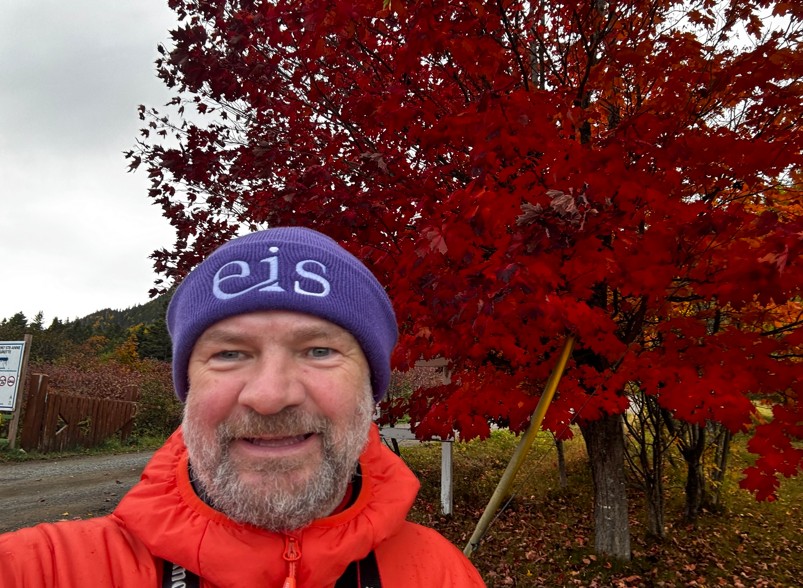
The second week of the trip was all about trade union solidarity between north Atlantic colleagues. On the Monday morning, I made my way, through frankly Scottish level rainfall, to CSQ HQ in Québec City to meet the President and Vice-president of the school support staff federation (FPSS – CSQ), whose membership covers 81 different categories of employment.
This branch of the CSQ has been at the forefront of the campaign against violence in schools for over 2 decades. Their survey results mirror findings of our own but they have had to resort to a dedicated campaign of Freedom of Information requests to wring details of violent incidents from employers.
In the afternoon I met with a representative of the teaching unions federation (FSE – CSQ) to discuss violence in schools from the teachers’ unions perspective. I found this particularly fascinating as they had decided to focus their most recent member survey on incidences of incivility in schools (this included instances of verbal incivility, classroom disturbance, non-verbal communication, lack of respect of people and property amongst others).
The next day I travelled north from Québec City, flanking the majestic St Lawrence River, to La Malbaie, where the General Council was to take place. The delegates at this event are the Presidents and Vice-Presidents of the constituent unions of the CSQ.
The conference started the following day, and after opening ceremonies and speeches, myself and the other international delegates took to the stage. Joining me in person was Manuela Mendonça of the Portuguese teaching union, FENPROF and online Salvatore Marra of CGIL, the Italian TUC.
The conversation was led by CSQ President, Eric Gingras, who posed questions on the right to strike, how collective bargaining in our countries works, how union dues are collected, how unions try to influence public discourse and finally the health of the union movement and how we see the movement evolving in our locations.
We had had the questions in advance, so I was well prepared and my French was, in general, accurate. The room was then opened up for questions from the floor. Thankfully the delegates were kind and didn’t ask anything we had much difficulty answering.
Over the next two days I thoroughly enjoyed mixing with the other delegates, discussing their issues and realising that no matter where you are, educators the world over are encountering similar challenges.
This is where international trade union solidarity is vital; if sisters and brothers in one union find a solution to a common problem we can learn from and adapt that solution to our own settings.