
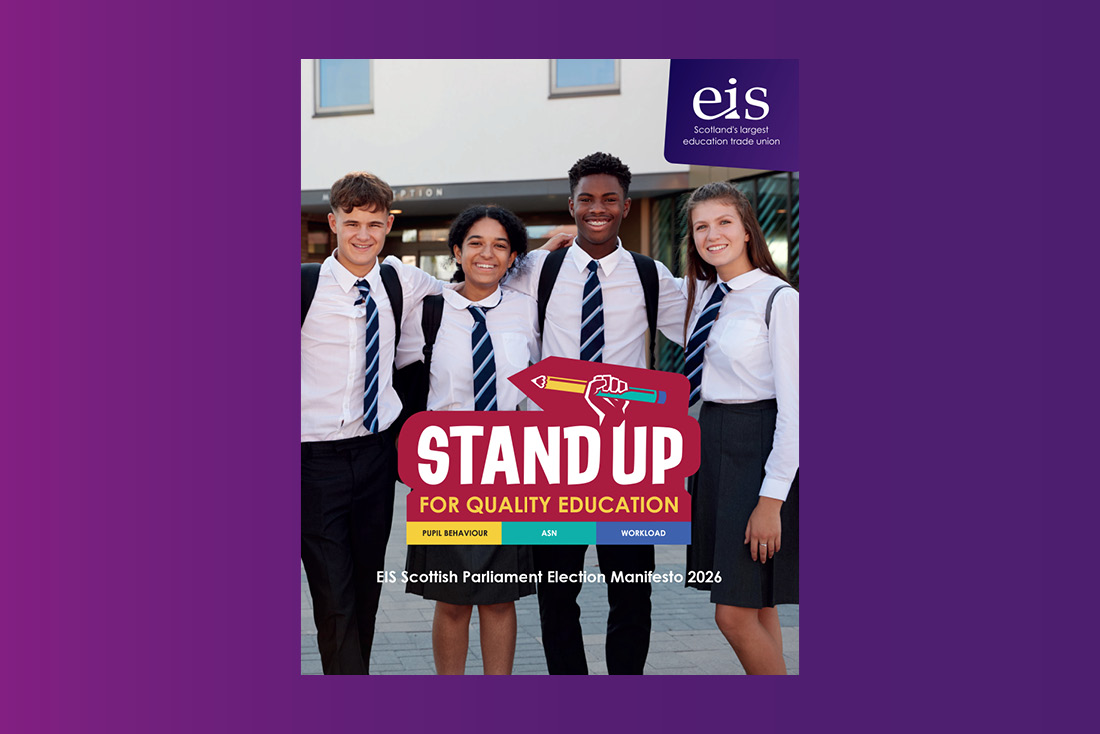
A s members will know, the EIS is not affiliated to any political party. It is important to highlight this from the outset because, as the EIS launches its manifesto for the Scottish Parliament elections, we want to be very clear that the EIS is promoting the best interests of Scottish education, and not pushing the policy of any political party.
The EIS is proud to publish its Education Manifesto for the Scottish Parliament elections, and to play its part in the democratic process. The key themes of our Manifesto highlight the value of education to society, and the importance of investing in our schools, colleges and universities.
The EIS would urge all teachers and lecturers, and everyone else interested in education, to read the manifesto, to question politicians and political parties over their commitment to Scottish education, and then to use their votes in this hugely important election. Democracy is an essential part of our society, and it is important that every eligible voter has their say by exercising their right to vote.
An independent analysis
The EIS Manifesto incorporates research and costings by the Institute for Public Policy Research Scotland (IPPR Scotland), providing an independent analysis on EIS policy priorities for Early Years and school education in Scotland.
The launch of the EIS Education Manifesto lays down a significant marker to politicians of all political parties. Education is amongst the most important of devolved issues for the Scottish Parliament and the Scottish Government, and must be a major focus of all parties’ election campaigns, though without it being treated as a political football.
The Manifesto sets a range of policy priorities for Scottish education, and calls on Scotland’s politicians to meet those challenges. Education is the bedrock of our society, and it must be fully respected and properly supported, including with increased investment, by politicians from all points of the political spectrum.
Standing up for Scottish education
The EIS Manifesto highlights current inadequate investment in education, and places a spotlight on the implications of this under-investment for learners of all ages, and particularly young people, across Scotland.
For school education, the EIS Manifesto outlines 5 key policy priorities for Early Education and schools, which have all been independently modelled and costed by IPPR Scotland:
- Reduce all class sizes to a maximum of 20 pupils.
- Reduce weekly class contact to a maximum of 20 hours.
- Restore the number of Early Years GTCS-registered teachers to at least 2012, ideally 2007, levels.
- Put in place the requisite additional staffing and resources to fully implement in practice the relevant legal duties and commitments for all pupils with additional support needs.
- Provide Universal Free School Meals to all school pupils.
Commenting on the publication of the Manifesto, EIS General Secretary Andrea Bradley said, “The EIS believes that the policies outlined in this manifesto can deliver a brighter future for Scottish education, and for our young people.

There are, of course, costs involved in properly funding education, but this should be seen as an investment in our young people and in the future of our country and our society. Based on the independent research by IPPR Scotland, the view of the EIS is that these costs are entirely manageable for a wealthy country such as Scotland – it will be a matter of political choice for the next Scottish Government, no matter what its political hue, as to how it takes forward these challenges to properly invest in and support Scottish education.”
Dave Hawkey, senior research fellow at IPPR Scotland added, “Investment in education strengthens the foundations for the future, helping our young people develop and look forward to prosperous lives. But it is also important for enhancing the wellbeing both of staff and students during their time at school. The costs we have estimated for implementing these policies are not insignificant, but international evidence suggests it is highly plausible that these would be outweighed by the benefits.”
Will the politicians rise to the challenge?
Scotland’s teaching professionals, Scotland’s learners and Scottish society as a whole, deserve to know exactly what each party would offer for Scottish education, not only for the short term but, critically, the long-term vision.
The EIS will be sharing and discussing our policy priorities with Scotland’s politicians, and urging them to match our ambitions for Scottish education, its learners and its teaching professionals.
It is through education that we can support and enhance the health and prosperity of our society, its democracy and social cohesion, and that is why all of Scotland’s political parties must make clear their own policy priorities for Scottish education.
The EIS Manifesto will play an important part in supporting this process, for the benefit of citizens of all ages across Scotland.
The current climate
As we publish our Manifesto for the 2026 Holyrood election, the EIS is, of course, still pushing for the Scottish Government and local authorities to deliver promises made five years ago to Scottish education, its teachers and its students prior to the previous election in 2021.
Pledges were made to tackle excessive teacher workload, to employ 3,500 additional teachers, and to reduce teachers’ maximum class contact time commitment to 21 hours per week. None of these commitments have been met.
The EIS is currently balloting members for industrial action due to this failure to deliver. As with the Scottish Parliament elections, it is essential that every eligible EIS member has their say and plays their part in the democratic process by using their vote in this vital postal ballot.
Politicians must be made to keep their promises, and only by EIS members using their votes in this industrial action ballot can we hope to compel those in power to keep those promises.