
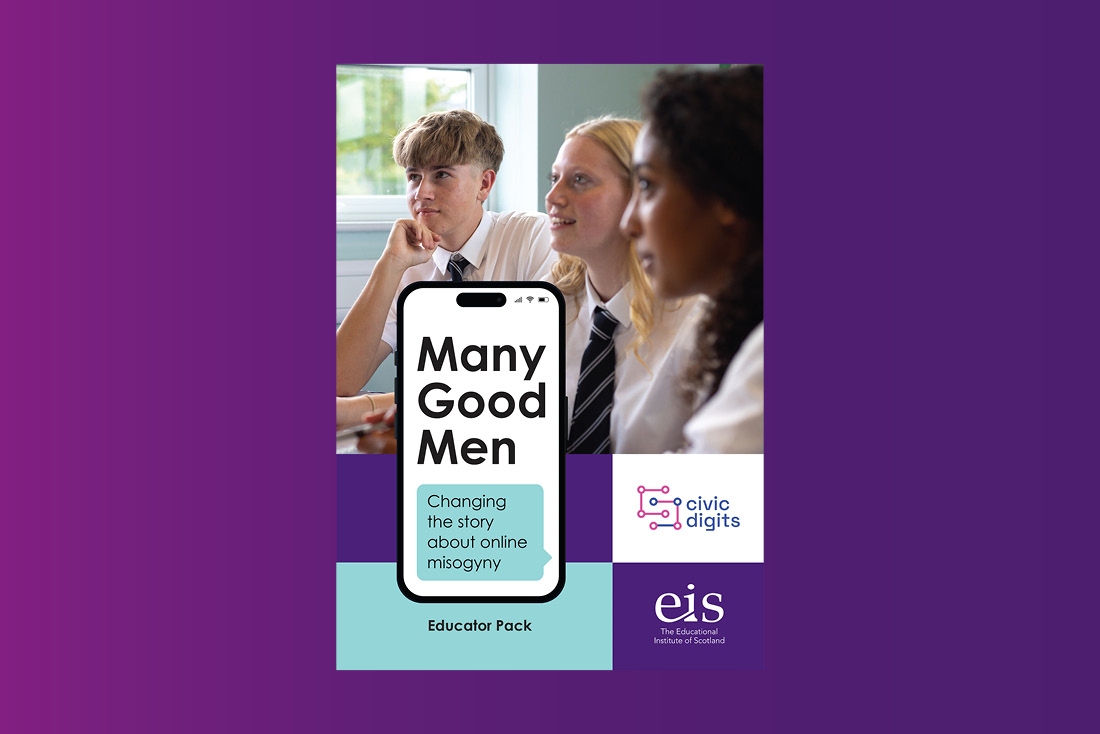
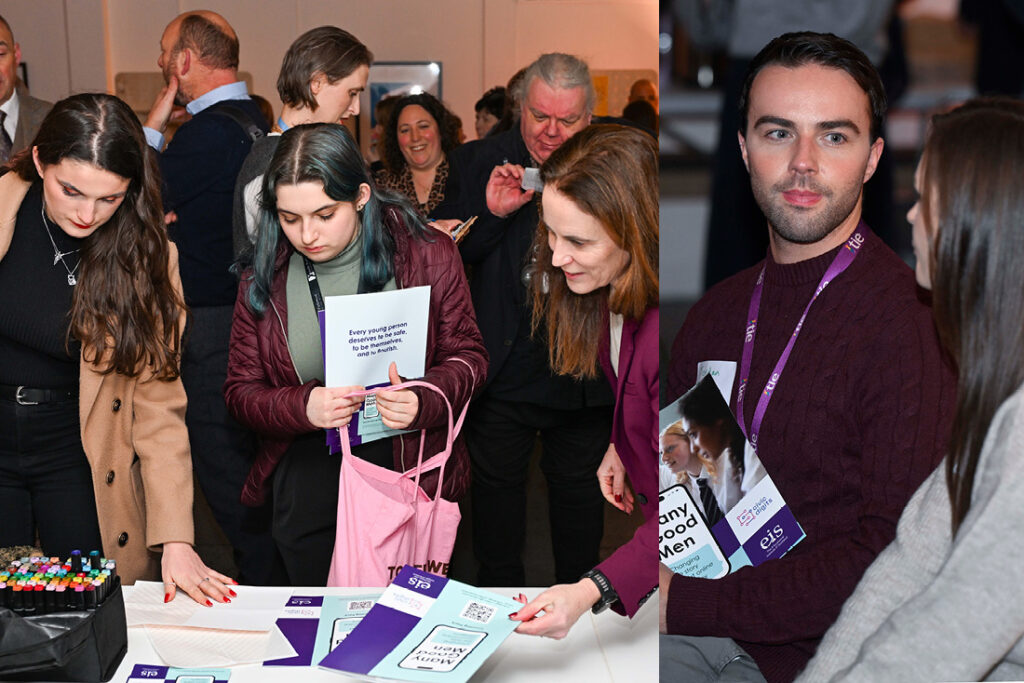
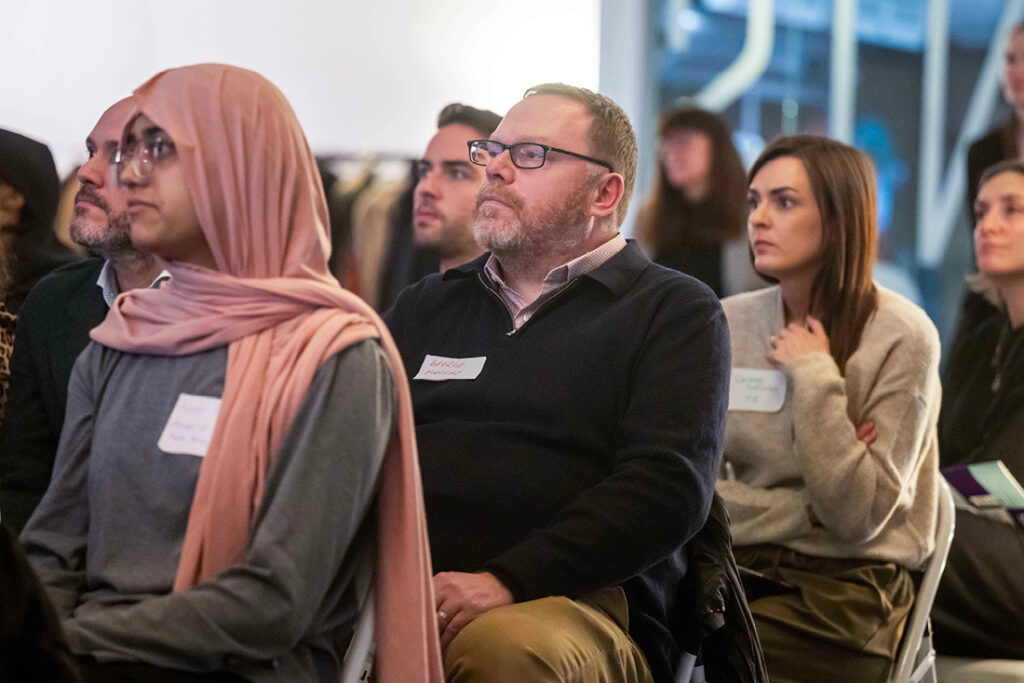
The launch of the Many Good Men resource brought teachers, policy-makers, youth workers, charitable organisations and young people together for a night of reflection, discussion and challenging conversations.
Opening the event, Clare Duffy, Artistic Director at Civic Digits, introduced the origins of the Many Good Men project. She spoke about the urgent need to confront harmful stereotypes of men and boys, while actively creating spaces where positive masculinity can be explored and supported.
“It has never been more important than now,” Clare said, highlighing growing concerns around misogyny, online radicalisation and young men’s mental health. She closed, introducing EIS President Adam Sutcliffe.
Adam reflected on the EIS’s role in advancing social justice and equality across Scottish Education. “The impetus for the EIS to collaborate with Civic Digits on this project, comes from the evidence of our members’ own lived experiences. Nearly 83% of our school branches reported incidents of violence and aggression every week, with 40% noticing an increase in prejudice-based violence over the 4 years prior.”
Attendees were then introduced to a documentary following the creation of two participatory theatre projects, made by young participants.
The documentary confronts its subject matter head-on, introducing terminology increasingly encountered by teachers and youth workers, “incel, manosphere and chads”.
Viewers are then introduced to the two groups of young students, analysing the characteristics of someone vulnerable to radicalisation: loneliness, isolation, insecurity, exposure to violence, pressure from parental figures and a lack of emotional understanding from adults in their life.
The documentary sees young people navigate challenging themes like violence against women, pornography and abuse through fictional characters. One of the central characters, ‘Stirling’, becomes a case study in how radicalisation develops through everyday interactions with parents, peers and online influencers.
Crucially, the young people involved critically reflect on who benefits from creating misogynistic content targeting young men and boys. Online masculinity influencers are positioned not simply as extreme voices, but as figures who profit both financially and socially from young men’s alienation. The documentary also explores what protective factors might have altered ‘Stirling’s’ trajectory. The groups involved suggest the presence of positive role models, an older sister, a coach, a peer mentor, and highlight the importance of connection and understanding in building resilience and preventing vulnerable men and boys from harm.
The education resource, developed in partnership with Civic Digits and EIS, offers educators scripted stories from ‘Many Good Men’ stimulus as well as tools and plans that aim to open learners’ imaginations and engage them in discussion about how they can change the trajectory of the characters in these stories, and ultimately, better understand and challenge misogyny in their own lives.
Following the screening, a panel discussion brought these themes into conversation. Three young people involved in the performances took part: Distinguish, now a University student; Ethan, a final year student in secondary; and Mairi, who is undertaking an apprentice in Early Years practice.
“I didn’t realise how dangerous incel culture was,” Ethan reflected. “Or the extent of misogyny. Being part of this helped me understand it better and how to recognise when someone might be at risk.”
Mental health was identified as a key factor of vulnerability. Ethan spoke openly about how poor mental health can make young people more susceptible to radicalisation online, particularly when support from family or friends is lacking. He described how the documentary illustrates this progression clearly: ‘Stirling’ initially resists the content but gradually becomes immersed as his wellbeing deteriorates.
The panel emphasised that while anyone can be exposed, risk is shaped by context. Unsupportive or abusive environments, poor mental health, the absence of role models, and harmful behaviours normalised at home all increase vulnerability. As Distinguish noted, even young men raised with positive values may underestimate how different circumstances can shape their beliefs and behaviour.
Mairi highlighted how misogyny subtly operates in school and social environments. “Small comments, jokes, names, people don’t always recognise the impact,” she said. She also drew attention to the way far-right and misogynistic influencers – and social media companies by extension – exploit men’s poor mental health, often for profit. “This isn’t new,” she added. “Women have long been knowingly put at risk by industries and corporations prioritising profit over women’s safety”
Distinguish referenced the role of social media algorithms in furthering extreme content but stressed that users still “bear responsibility for the actions they take to deepen themselves in incel culture online”. He also challenged damaging gender norms, “We tell boys not to cry, but everyone cries. We are all allowed to.”
During the Q&A, the focus shifted to policy and practice. On calls to ban social media on phones for under-16s, the panel were sceptical. Ethan warned that blanket bans could reinforce arguments of incels online, claims of being “silenced” turn social media bans into proof and validation of their arguments.
Distinguish argued that schools should see digital platforms as spaces for positive intervention. Mairi placed responsibility with government and technology companies, calling for stronger regulation of disinformation, misogyny and hate online.
Another key area for the audience was the relationship between misogyny and pornography. Ethan reflected on the value of online safeguarding measures, explaining that limited exposure when younger enabled him to reject violent pornography as incompatible with his values.
Mairi stressed the need for comprehensive, age-appropriate sex education, noting that many young people model expectations around sex and relationships on pornography.
Distinguish added that where harm has already occurred, education systems must prioritise rehabilitation and support rather than punishment, “Conversations around sex have to happen early on and if we miss the opportunity to have those early interventions then there must be a system of rehabilitation.”
As the evening concluded, the discussion returned to the notion of belonging, within schools and within families. Ethan spoke candidly about the importance of respectful, non-judgemental, communicative family and teacher relationships, “families need to help their young people in a way that is still loving them,” adding, “without my family, I could have been at risk.”
Mairi emphasised the need for schools to validate emotions and explicitly teach what healthy relationships look like. Distinguish shared a positive message from his own family that could be used in schools as well, “when I do something wrong, the first place I should run is to my family not away from them”. He also called for increased professional learning for school staff to support them to recognise early signs of misogyny-related attitudes among young men and boys.
Closing the event, Clare Duffy thanked the panel and attendees, encouraging continued dialogue across sectors.
EIS members can access the Many Good Men resource on the EIS website. This resource is intended for use in upper secondary and college settings and includes an educator pack, a learning pack and links to further resources.
Civic Digits’ ‘Play in a Week’ process is available for booking.
If you would like Civic Digits to run a participatory theatre project or workshop in your establishment, please get in touch with them via email: contact@civicdigits.com