
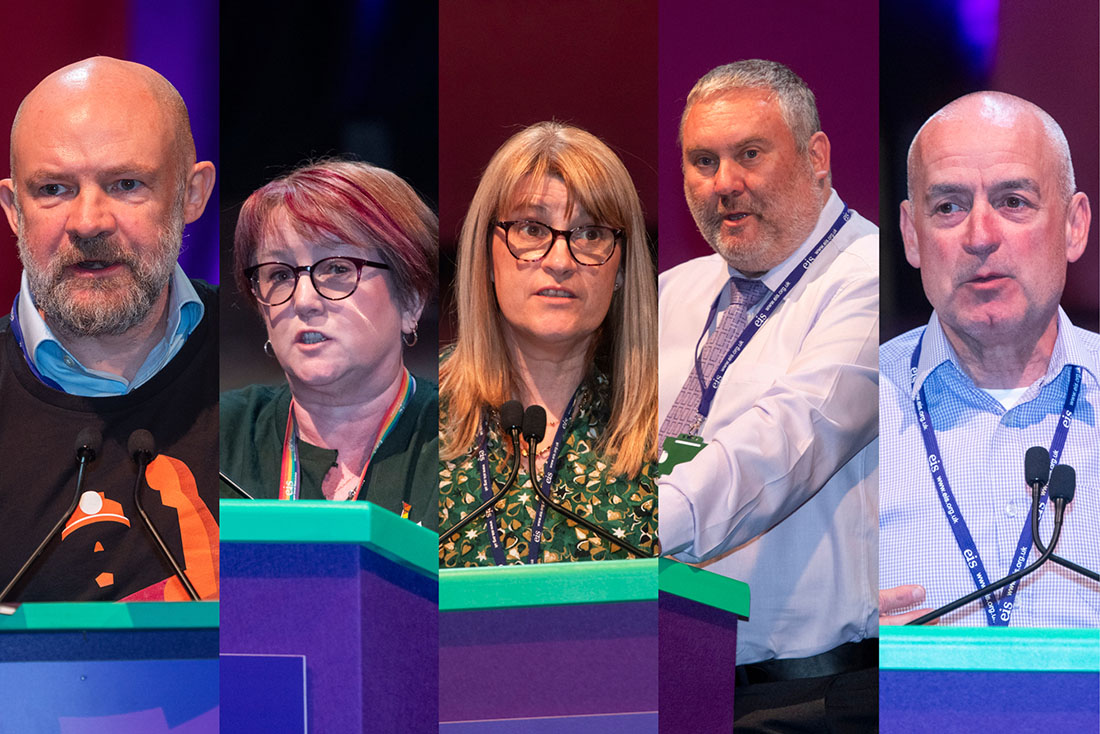
September’s meeting of EIS Council, the first of this academic year, welcomed many new members of Council to their first meeting. While some members were new, the issues under discussion had a familiar theme, as continuing disputes in both the Further and Higher education sectors rolled on.
Ex-President Adam Sutcliffe delivered the report of the Executive Committee on behalf of Vice-President Valerie Inkster, who was absent on other EIS business. Mr Sutcliffe updated Council on the ongoing dispute at Glasgow Caledonian University (GCU) over proposed job cuts, including plans for coordinated industrial action alongside other unions representing staff at the University.
Mr Sutcliffe also updated Council on the long-running Health & Safety dispute at City of Glasgow College, where strike action has now been ongoing for well over six months. Lecturers in the Welding and Fabrication department at CoGC are continuing to seek Respiratory Protective Equipment (RPE) to protect their health and that of their students.
With no sign of movement from the college, the EIS has stepped up its campaigning and has written to the First Minister, urging him to intervene in the dispute.
Andrew Fullwood (Glasgow) asked Mr Sutcliffe what members or Local Associations could do to offer meaningful support to colleagues currently on strike at GCU and CoGC.
Mr Sutcliffe replied that messages of solidarity from Local Associations were always appreciated by branches engaged in industrial action, and that individual members who are in the area where strikes are taking place are welcome to visit picket lines to show their support, if this does not interfere with their own contractual working commitments.
Education Committee
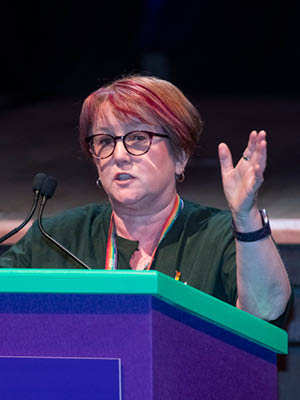
Convener Susan Quinn updated Council on the work of the Committee, highlighting that Education Reform continues to be a major focus, particularly with changes to national bodies and, now, the Curriculum Improvement Cycle (CIC).
Specifically on the CIC, Ms Quinn said that the time that has been allocated for this piece of work is wholly insufficient. The Scottish Government announcing a grand total of two inset days for a programme of complete curricular reform is completely inadequate, she said. “Not only have they failed to declutter the curriculum, they are now actively adding more things into it,” said Ms Quinn.
Ms Quinn also highlighted that the timeline of August 2028 for full implementation is totally unrealistic, the proposals are still in draft, and very little is currently clear. “What is needed is an extension to this timeline, a case we have made and will continue to make very strongly,” she said.
Employment Relations Committee
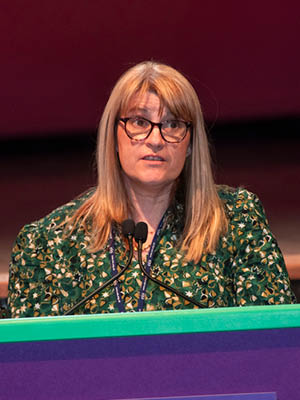
New Employment Relations Convener Jacqui MacKenzie updated Council on the Benevolent and Legal Affairs work of the Committee.
On Benevolence, Ms MacKenzie told Council that the Committee had considered 30 applications of assistance, and that 30 grants totalling £83,750 had been approved.
On legal affairs, Ms MacKenzie said that 65 cases had been considered by the Committee, and noted that settlements totalling £760,000 had been achieved on behalf of six members injured in the course of their work.
“Compensation will not turn the clock back for these members, but employers need to be held accountable to help reduce risk and also to reduce the number of accidents in the future.
“We must continue to encourage our members to report accidents and injuries in the workplace,” said Ms MacKenzie.
Equality Committee
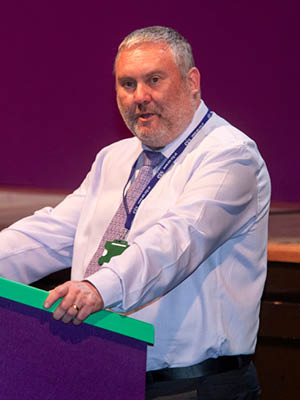
The Equality report was delivered by President Mark Smith, as Convener Nicola Fisher was absent on EIS business.
Mr Smith told Council that work on disrupting disinformation continues, with a new project entitled, “Let’s change the story in your school,” being developed with the Time for Inclusive Education (TIE) campaign.
Mr Smith also reported that work was ongoing to promote the use of EIS ‘Welcome Packs’ for young people new to Scotland.
A copy of the early years welcome pack, ‘Mochara Goes to Nursery’ has been sent to every local authority nursery in Scotland to increase awareness of the publication.
The EIS has distributed a total of 1,968 welcome packs since June this year.
Salaries Committee
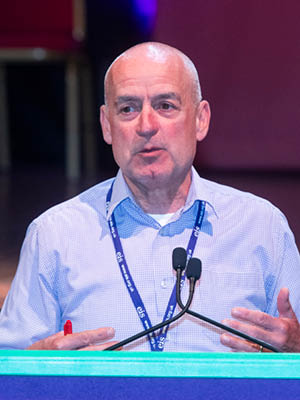
Convener Des Morris updated Council on a range of issues, including the implementation of SNCT agreement on 21 hours class contact.
Mr Morris said that the Teachers’ side of the SNCT has sought assurances that digital learning was not being considered as a means of delivering the agreement on reduction of class contact time. These assurances had been received from both Scottish Government and CoSLA, and unions will use all means to hold them to this, he said.
On the issue of the CIC and additional in-service days, as referenced in the Education Convener’s report, the Teachers’ side has written to the Scottish Government expressing serious concerns, including the lack of any additional in-service days, other than the two previously announced days, to support work on the CIC at school level.
Implementation of the CIC can only happen if teachers are given sufficient time to engage in the process effectively, reiterated Mr Morris.
Stand Up for Quality Education Update
General Secretary Andrea Bradley updated Council on progress of the EIS Stand Up for Quality Education campaign. “The campaign has been live for the past 3 years, and we have achieved some significant success, but still have a way to go to achieve all the aims of the campaign,” said Ms Bradley. See focus on pp12-13 for more on the SUFQE campaign.
Motion
Alison Murphy (Edinburgh) was successful in proposing that the EIS should donate £10,000 to relief efforts following the recent flooding in Nepal/Tibet, with the focus to be placed on restoring educational capacity through appropriate agencies identified by Education International or other appropriate partners.