
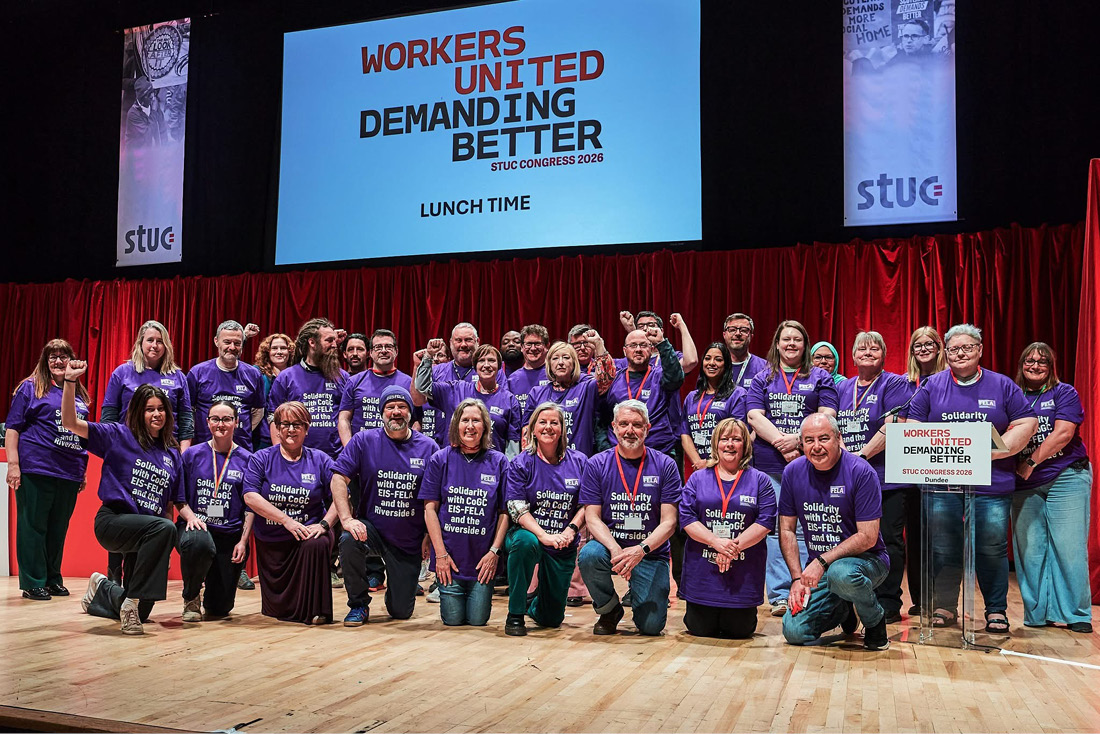
The EIS is one of the largest affiliates to the Scottish Trades Union Congress (STUC), and played a prominent role in this year’s annual Congress at Dundee Caird Hall.
The theme of this year’s Scottish Trades Union Congress was Workers United, Demanding Better. This was an important reminder of the collective strength of workers through the trade union movement, at a time when the rise of anti-worker, anti-trade union and anti-unity politics continues to threaten the rights and living standards of workers across the country.
The EIS is proud to play a prominent role in the work of the STUC, and to send a sizeable delegation to Congress as one of the larger STUC affiliates. EIS representatives moved or seconded four motions during this year’s Congress, calling for proper funding of education and action to tackle childhood poverty, reductions in staff workload and improvements to staff wellbeing, action to tackle the crisis in post-16 education, and action to tackle the influence of the far-right in education establishments.
Significantly, the EIS also brought an emergency motion to Congress on a critical issue which does, quite literally, represent an emergency situation for those involved – the current dispute with City of Glasgow College, and ongoing programme of strike action, over a serious health and safety issue at the college’s Riverside campus.
EIS Motions
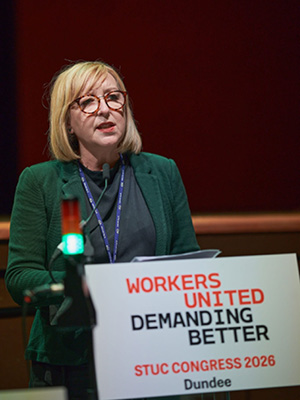
The first at this year’s Congress was an EIS motion on education funding and tackling childhood poverty, and was moved by General Secretary Andrea Bradley. In her speech, Ms Bradley highlighted that there are around 250,000 children and young people in Scotland living in poverty, which is completely unacceptable.
Political choices made by successive governments have compounded the problem, and progress to close the poverty-related attainment gap has been glacial at best. We continue to have Victorian style education infrastructure, but with 21st century expectations and demand being placed upon the education system.
We require thousands more teachers and support staff in our schools to meet the needs of young people, and to ensure that workload is manageable. As the EIS education manifesto has recently illustrated, there is money available, if there is the political will.
The motion was seconded by Bill Ramsey, a former EIS President and current Chair of South Lanarkshire Trades Council, and received support from Unison Scotland before being carried unanimously.
EIS President-Elect Mark Smith moved a motion on reducing workload and improving staff wellbeing in education, saying that the number of pupils with ASN is now more than 40% and rapidly heading towards 50%. He highlighted that teachers working, on average, an extra day per week, unpaid, to keep on top of their workload. Mr Smith said that the new Scottish Government must take action to address workload, as a matter of urgency.
extremists are increasingly targeting young people online, and we are seeing the consequences in our schools
Holly Patrick-Thompson, President of the EIS University Lecturers’ Association (EIS-ULA), seconded a motion on the crisis in post 16 education, highlighting the increasingly perilous funding situations in Further and Higher education.
Ms Patrick-Thompson said that staff are increasingly paying the price of a sector-wide crisis, with job and salary cuts. Governance mechanisms have failed to provide the appropriate independent scrutiny that holds Principals to account. The Scottish Government must fully fund post-16 education, she added.
Tackling the influence of the Far Right in Scotland’s education establishments was the theme of a motion, moved by EIS President Adam Sutcliffe who told Congress that extremists are increasingly targeting young people online, and we are seeing the consequences in our schools. The motion demands funding for equality education, training for educators to counter extremism and radicalisation, and action to protect teaching staff from intimidation from those pushing these narratives on young people. Support is needed from government and from employers to counter these dangerous narratives, he said.
EIS Emergency Motion
In this article we highlight in depth the reasons behind the emergency motion on City of Glasgow College that the EIS brought to this year’s congress.
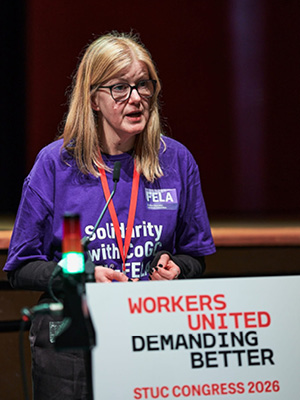
Moving the motion, Thora Hands (EIS-FELA, City of Glasgow College branch) said, “This dispute began when our members raised concerns in relation to their health & safety. They are being exposed to substances which are known carcinogens, substances of which there is no safe level of exposure.
Members are breathing in these substances day in, day out, without appropriate safety mitigations. You might expect management to act swiftly and to work with the union to address these concerns – but they have not. Instead, they have attempted to shift the blame onto staff.”
Seconding the motion, Lynn Davis, speaking in her capacity as Chair of Fife Trade Council, said, “This is a fundamental failure of employer responsibility. Staff are being forced away from their classrooms because they do not feel safe to be there. This is a publicly funded institution, it is supposed to embody fair work principles. Workers should not be forced into conflict just to secure basic protections.”
International Statement
General Secretary Andrea Bradley moved the International Statement, on behalf of STUC General Council. The statement recognises the current deeply troubling international situation, including the launch of an unprovoked war in Iran by the President of the United States, the kidnapping of the elected president of Venezuela, the blockade of Cuba, attacks on ships in international waters, threatened military action in Greenland, and continued use of tariffs against the UK and other nations.
The ongoing bombing of Lebanon, Gaza and the acceleration annexation of the West Bank by Israel were also referenced in the International Statement.
Moving the motion, Ms Bradley said, “Our own governments are complicit. The UK Government continues to arm Israel. Scottish Government-owned airports are being used for US military flights to the war in Iran. We must pursue greater sovereignty, and reduce our reliance on the US.
We must forge new alliances – closer ties with Europe, better relationships with the global south, and an improved relationship with China. Remaining tied to an increasingly aggressive and unpredictable power is dangerous. Our security, our prosperity, and our society depend on it.”