

The recent ULA Annual Conference saw members from across Scotland’s higher education sector come together in Edinburgh, with guest speakers Andrew McGettigan, a financial and policy analyst specialising in UK higher education, Yvonne Evans, a senior lecturer specialising in Scottish trusts, charities and tax law, and Terence Karran and Dr Chavan Kissoon both specialising in academic freedom.
This year’s conference brought together members and activists from across the sector to reflect, challenge and share their views on The Future of Higher Education in Scotland, considering pressing issues our members, students and the higher education sector as a whole are currently facing.
EIS ULA President Holly Patrick-Thomson opened conference with an overview of some of these issues, stating that the social contract within many of our universities feels like it has been broken, and many have ceased to serve the communities for whom they exist.
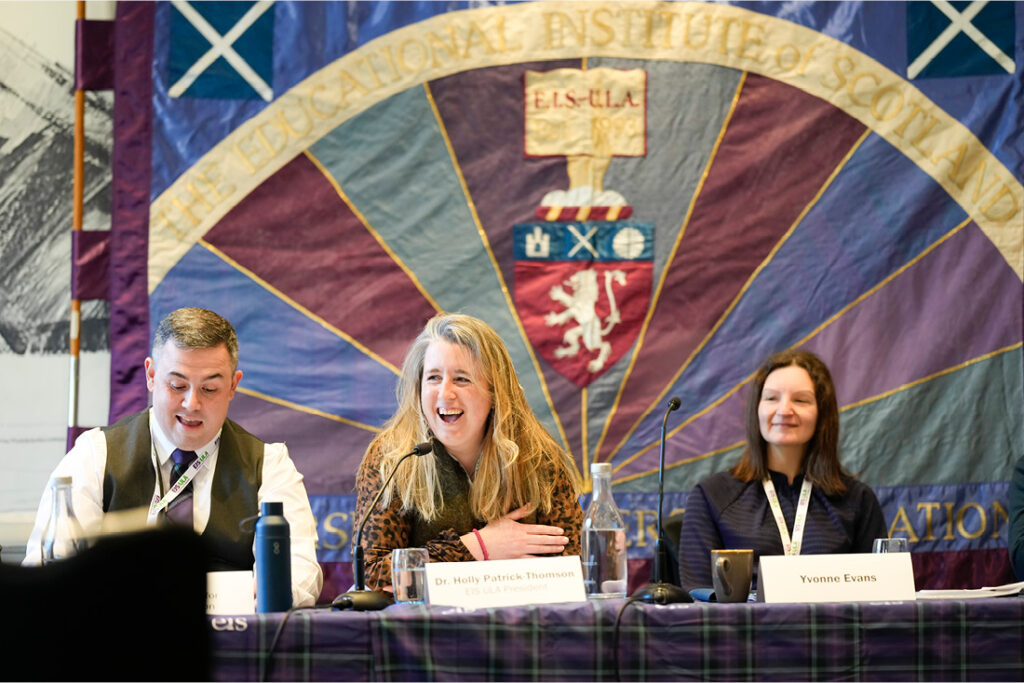
Ms Patrick-Thomson stated that universities are not businesses. They were founded with the key ambitions of knowledge production, research and discovery for scholars and learners, but who do they serve now? Growth has become the primary objective for many universities as they face pressure to be bigger, more influential and more profitable. This is not in the interest of staff or students but primarily benefits senior management.
Prior to debating this year’s motions, delegates heard from our speakers beginning with Andrew McGettigan, who spoke about financial governance and encouraged members to familiarise themselves with their establishments finances and annual reports. Speaker Yvonne Evans then addressed conference, providing an overview of legal status and regulation of Scottish universities as charities.
Terrence Karran and Dr Chavan Kissoon joined the conference online to discuss academic freedom, which they described as a key variable in determining working conditions. They stated that transparency from universities is crucial to the health of academic freedom as lack of openness leads to lack of trust. If we don’t recognise the importance of academic freedom, working conditions can decline.
Speaking on behalf of the EIS teacher membership, EIS President Adam Sutcliffe focused his remarks on governance of universities and their charitable status. Mr Sutcliffe described universities as “not merely institutions that can be understood by looking at an organisational chart and spreadsheets of data, they are complicated and organic and no series of KPIs will ever truly describe what a university does.”
The EIS President stated that “the marketisation of universities is a disgrace and aligning research and teaching with pseudo-economic outputs is utterly nonsensical”, before highlighting the positive effect EIS ULA members can have on the higher education sector, not only for lecturers but also Scotland’s learners.
Over the course of the afternoon, a number of member led motions were discussed by conference delegates.
Motion 1, successfully moved by Cristian Surubaru (Napier), addressed the mismanagement in higher education. “Reforms have not gone far enough in addressing concerns around accountability, and in ensuring the transparency of our governing bodies. We want to continue to campaign for better and more meaningful staff involvement in the governance of HE bodies.”
Motion 2 concerning the defence of jobs against redundancies was moved by Damian Stantchev (Napier). Mr Stantchev highlighted that many institutions are in a good financial position with cash reserves, and do not have any need for cuts. “An injury to one is an injury to all. We make the university, in a way, we run the university.”
Seconding the motion Nick Cimini (Napier) stated that the cuts have “taken a toll on us all. If you take away more staff, the service we provide will suffer. Education is a public good and should be funded appropriately.” The motion passed unanimously.
Motion 3 resolved to continue to campaign in defence of free tuition. Moving the motion, Eleni Papagiannaki (Napier) said, “It is the duty of society and therefore the economy to supply us with educated employees. Higher education should not be a business for profit. Free tuition is a public good, across Scotland.” The motion was carried.
Motion 4 was successfully moved by Naveed Hakeem (GCU), who called for the establishment of a Scottish subcommittee of JNCHES in order to secure fair and sustainable pay bargaining arrangements for staff in Scottish HE.
Speaking in support of the motion, EIS ULA Vice-President Wojciech Kwiatkowski (UWS) said, “It’s not a pay negotiation framework, it’s a pay position framework. Every sub inflationary pay rise is a pay loss.”

Motion 5 was successfully moved by Catherine Clark (UWS), who urged conference to pursue the establishment of a national level negotiating forum on terms and conditions. Ms Clark stated that, “Our wages are nationally negotiated, yet there is a different expectation on our workload.”
Motion 6 called on conference to lobby for university senior leaders to be subject to the Public Sector Leaders’ pay framework and to engage in a commensurate promotion freeze exercise for senior managers in HE. Moving the motion, EIS ULA President Holly Patrick-Thomson (Napier) stated its’ importance because “senior pay is out of control”.
Speaking in support of the motion, David Griggs (Napier) said that “The reality is year on year, the income of senior management in Scotland goes up and our pay stays the same or goes down. Senior management are deluding themselves into saying on the one hand the sector is in a dreadful state and on the other hand, we deserve this high pay.” The motion passed unanimously.
“The reality is year on year, the income of senior management in Scotland goes up and our pay stays the same or goes down
Motion 7 was successfully moved by Nick McKerrell (GCU). The motion highlighted the varying modes of delivery of learning during covid and requested for these more flexible teaching methods to continue post-covid. “During covid we were told to learn how to successfully teach remotely. Since then, management has mandated that everything must be face to face.”
Catherine Clark (UWS), seconding the motion, stated that this was ultimately about micro-management and hybrid learning allows greater freedom for students to participate in their learning.
Motion 8 on formally recognising the need for fertility leave support for members and their partners, was moved by Katie McQuade (UWS). “At the moment a lot of universities do not have a designated leave policy. People are working while physically and mentally unwell. We don’t believe anyone should have to choose between their job and building a family.”
On seconding the motion Silvio Hofmann (UWS) said, “Holidays and sick leave should not be used for this. We recognise the impact maternity leave and adoption leave can have in helping to build a family. This is the next step.” The motion was carried.
Motion 9 was successfully moved by Nick Cimini (Napier) and called for conference to stand in solidarity with transgender people. “We know we are living in really challenging times. We see renewed efforts to divide our communities. The demonisation of trans identities has taken a shocking toll. Violence against trans people is on the rise. Fighting oppression must always be the starting point for us as unionists. Everyone deserves to work and study in an environment that is free from discrimination.”
Fighting oppression must always be the starting point for us as unionists. Everyone deserves to work and study in an environment that is free from discrimination.”
Motion 10 expressed solidarity with all those advocating for accountability and human rights protections in response to federal enforcement actions in the United States. Moving the motion, David Griggs (Napier) highlighted the collapse in trust of public institutions and growing alarm in what many see as a drift away from accountability and towards impunity.
Nick Cimini (Napier) spoke in support of the motion and stressed that this is not just a problem on the other side of the pond. “As unionists we should speak up against this hatred. We are a welcoming and multicultural city. This is a live issue not just in America but on our doorstep.” The motion passed unanimously.
EIS General Secretary Andrea Bradley brought conference to a close, thanking members for their activism across higher education picket lines, and reaffirming the full solidarity of the entire EIS.