
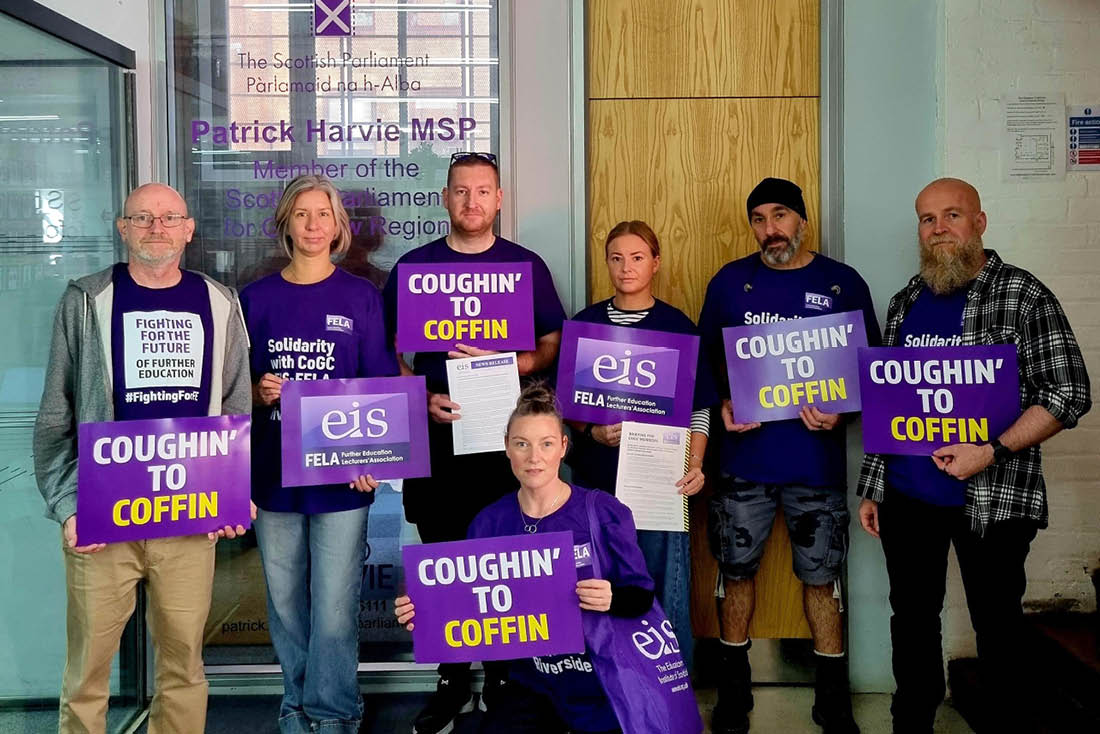
The EIS and STUC have written to First Minister John Swinney, urging the Scottish Government to intervene to help facilitate a resolution to the long-running Health and Safety dispute at City of Glasgow College (CoGC).
EIS members within the Welding and Fabrication Department at CoGC have been engaged in a programme of strike action since March, as they seek vital improvements to protections for staff and students undertaking hazardous welding activities in the college.
In the letter to the First Minister, EIS General Secretary Andrea Bradley and STUC General Secretary Roz Foyer highlight that the Health and Safety dispute remains unresolved after more than six months, despite there being a very simple route to resolution.
The letter then calls on the Scottish Government to exercise its overall responsibility for CoGC as a public body and intervene to facilitate the resolution of the dispute.
The letter highlights that the core of the dispute is the continuing refusal by CoGC to provide staff and students with Respiratory Protective Equipment (RPE) to reduce the risk of exposure to known carcinogenic materials to a level that is as low as reasonably practicable.
Commenting, EIS General Secretary Andrea Bradley said, “Welding lecturers at City of Glasgow College are now in their sixth month of strike action, as they seek vital protections for themselves and their students, in line with established industry practice.
“No-one should have to go into their place of work, or their place of education, with their health being put at potential risk. It is simply incredible that, rather than implement the very reasonable and straightforward safety procedures that are being asked for, the management of City of Glasgow College have chosen to provoke and prolong this long-running dispute and programme of strike action.”
Ms Bradley added, “It is well past time for the management of City of Glasgow College to listen to the very valid concerns of lecturers, and take the necessary steps to reduce the risk to staff and students undertaking welding to as low a level as possible.

“If CoGC management will not take these actions of their own accord, they must be compelled to do so by instruction from the Scottish Government.”
STUC General Secretary Roz Foyer said, “It’s utterly shameful, if not completely unsurprising, that the City of Glasgow College still lack the leadership capabilities to protect their workforce and their students from harmful working and learning conditions.
“It frankly beggars’ belief that workers must take this action whilst college management sit idle, inexplicably deciding to sacrifice the safety of their workers despite a simple solution being presented by EIS members.”
Ms Foyer added, “No worker should have to take industrial action simply to be safe at work yet that is exactly where these lecturers have been driven. If college management won’t do what is necessary, the Scottish Government must step up to the plate and hold to account, what is a public institution, the college, for their gross mismanagement of this dispute and their clear failings to their workforce.”
In calling on the First Minister to intervene, the joint letter states, “It is both disappointing and troubling that such intervention is needed in 2026 to ensure that public sector workers in Scotland can feel safe at work…what we are calling the Scottish Government to do is consistent with its own policies and the values it espouses in being on Scotland’s side and on the side of workers.
“Intervening now will not only protect the health of workers and their students in the public sector, but also meaningfully help Scotland’s progress as a Fair Work Nation.”
Why are the welders on strike?
- A lecturer welding became unwell and visited their GP in November 2025. It became clear that they were being exposed to welding fumes without adequate safety measures in place. Welding fumes are associated with acute and long-term health damage.
- After seeking to resolve these issues with the college, and only being met with denial and delay, EIS-FELA were forced to declare a trade dispute with CoCG on 24 November 2025.
- The Health and Safety Executive (HSE) inspected the welding workshop at CoGC in December 2025 and found the employer to be in material breach of the law. The college made changes and carried out tests which gave test results that are compliant with the law. The EIS is concerned that these tests did not reflect real-life conditions.
- The college refused to provide air-fed masks as RPE to the lecturers. The college has advised EIS-FELA that cost is not a factor in the dispute. The EIS has argued that the college should provide RPE in order to reduce the risk of carcinogenic fumes to “as low as reasonably practicable.”
- The strike has been about seeking to put pressure on the college to provide the RPE, update other risk assessments for workshop activities and to ensure no detriment to the strikers and the EIS reps at the branch
What has been done to resolve the dispute?
There have been numerous meetings between EIS-FELA branch representatives, area and national officers, and CoGC to resolve the dispute. Lately, there have been meetings between senior management at CoGC and the EIS General Secretary – all to deliver RPE for staff to be safer in work.
The EIS General Secretary has now written to the Chair of the Board of Management, the Minister with responsibility for Further Education and the First Minister requesting that the Scottish Government apply all possible pressure on City of Glasgow College, with a view to resolving both trade disputes in the interests of students and staff before there is any further disruption to the delivery of education.
The EIS is supporting welding colleagues taking action to protect their health as it places a marker down so that management also cannot ignore the safety of any other group or individual colleague at the college – the safety of one is the safety of all.
The welders’ strike is a consequence of the management culture at the CoGC
The EIS believes the college has dealt with the welders’ dispute in an aggressive manner with subsequent significant victimisation of trade union representatives.
Such action by the college is an example of a wider management culture at the college, and indicative of it failing to deliver the Scottish Government’s Fair Work First policy. This has led to a further whole College dispute being issued. It is time to address this culture at the college.
Our strength lies in our collective voice and in ensuring that no member or representative faces these challenges alone.