
The March meeting of EIS Council was held in unusual circumstances, with events happening elsewhere the main focus of everyone’s attention.
As Council members met in Edinburgh, a short distance away, political leaders from COSLA were also meeting to discuss the draft agreement on workload and class contact time, which had been accepted by both the EIS and the Scottish Government a few days previously.
The stakes were high. Should COSLA leaders accept the draft agreement, the EIS had already declared that the long-running SNCT workload dispute would be at an end. If COSLA leaders rejected the agreement, the EIS was prepared to move ahead with its planned programme of industrial action, including both national Action Short of Strike and, also, targeted strike action.
While Council members waited in the hope of white smoke emerging from COSLA’s Verity House HQ, the business of the meeting continued, albeit with phones and other devices being regularly checked for news.
Executive Committee
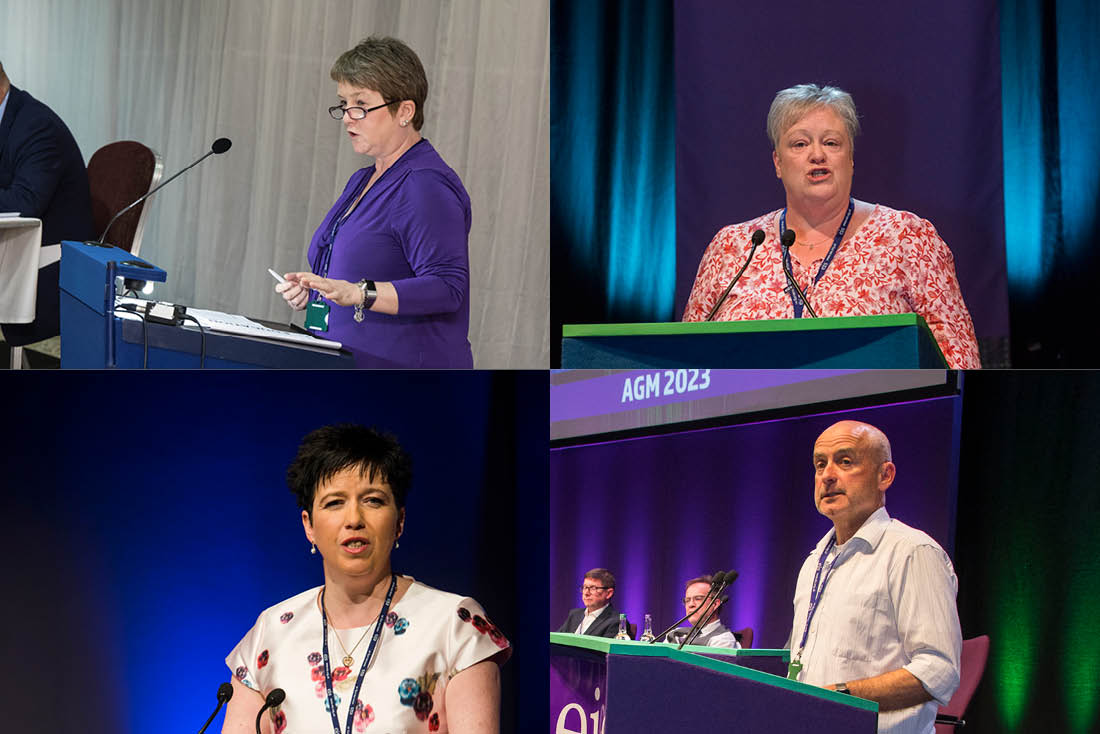
President-elect Mark Smith, reporting on behalf of Executive, provided Council with a round-up of the latest developments in the Workload campaign, including all the work that had gone into securing a successful statutory ballot result such as regular communications to members in a variety of mediums, a series of webinars, meetings at local association and school level, national and local advertising, video messages on social media, and a programme of co-ordinated phone banking across the country.
Mr Smith also advised Council of plans for regional hustings events in the run-up to the Holyrood election, and updated Council on recent strike action over proposed job cuts at Edinburgh Napier University and Craigclowan school in Perth, over pension cuts.
Education Committee
Convener Susan Quinn updated Council on the latest developments around Education Reform. Ms Quinn said that, whatever model is eventually pursed around education reform at national or local authority level, any change will be meaningless unless backed up with more teachers, more support staff, and more funding for additional resources.
Employment Relations Committee
Convener Susan Slater updated Council on the work of the committee, highlighting that 33 applications for assistance from the benevolent fund had been considered and a total of £90,500 of grants had been authorised. On legal affairs, the Committee considered 20 cases and noted that settlements totalling £26,800 had been secured on behalf of two members.
Equality Committee
Convener Nicola Fisher advised Council that work was underway to film a series of videos, as part of the Disrupting Disinformation United Workplaces project, to address the influence of the far-right through empathy based social dialogue. Ms Fisher also updated Council on a recent meeting between the EIS and Scottish Government regarding new RHSP advice for schools, about which the EIS retains numerous concerns.
Salaries Committee
Convener Des Morris updated Council on the many sets of discussions that had led to the draft agreement on class contact time with the Scottish Government. A special meeting of the Committee, held shortly before Council, had unanimously agreed that the draft deal was acceptable and that, should COSLA also agree to the deal, that a request should be made to Executive Committee to halt all planned industrial action.
The news arrives & the agreement is reached
At the conclusion of the meeting of Council, President Adam Sutcliffe announced that the long-awaited news had arrived – COSLA leaders had voted to accept the draft workload agreement. As a result, the EIS would cease all planned industrial action, and move to formalise the agreement through the SNCT at the earliest possible opportunity.
Speaking to Council following the President’s announcement, General Secretary Andrea Bradley said, “It has been a hectic week. I am delighted at the outcome. I’m not going to re-tell you the whole story of what has happened.
“This result today is down to every single one of you, every single EIS member and staff member, our Reps and activists, our negotiators, Salaries Convener Des Morris and Vice-Convener Mick Dolan. I would like to say it’s been a pleasure throughout, but what I can definitely say, is it’s an absolute pleasure to get this result as it has been so hard fought.”