
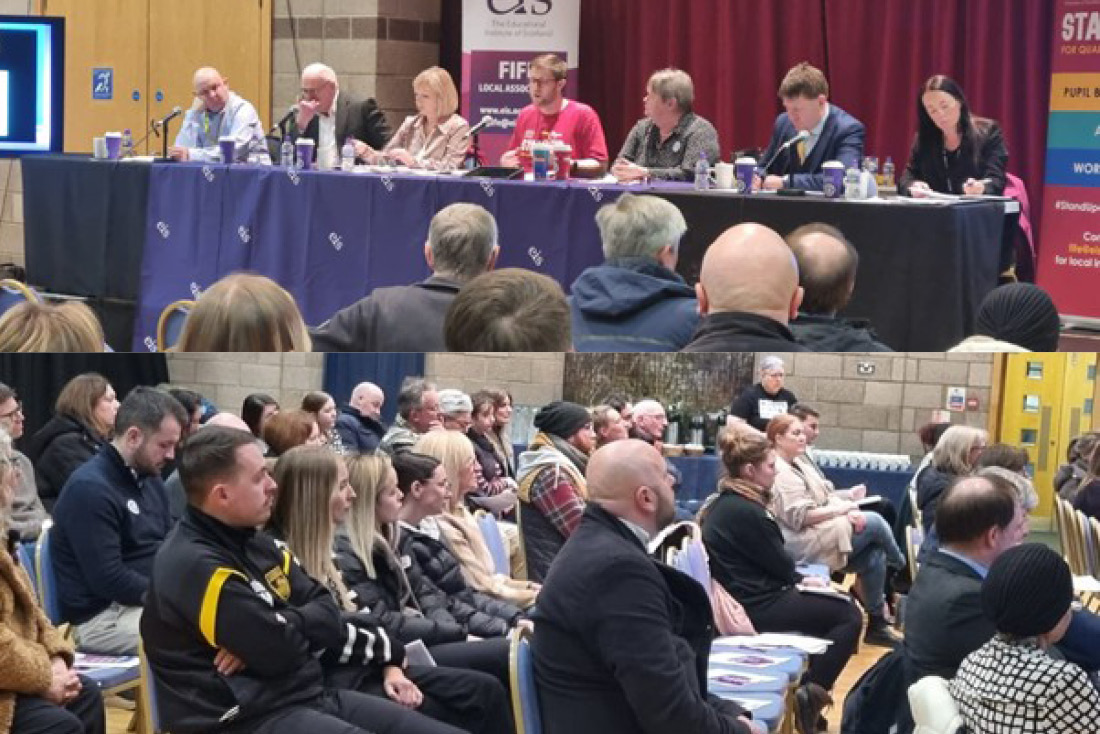
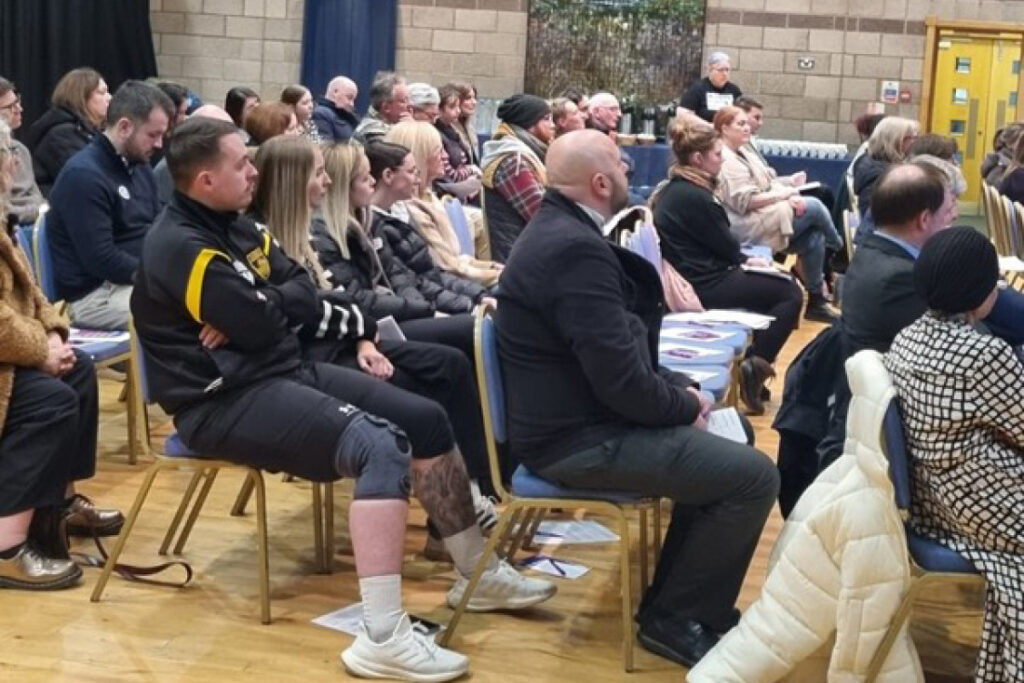
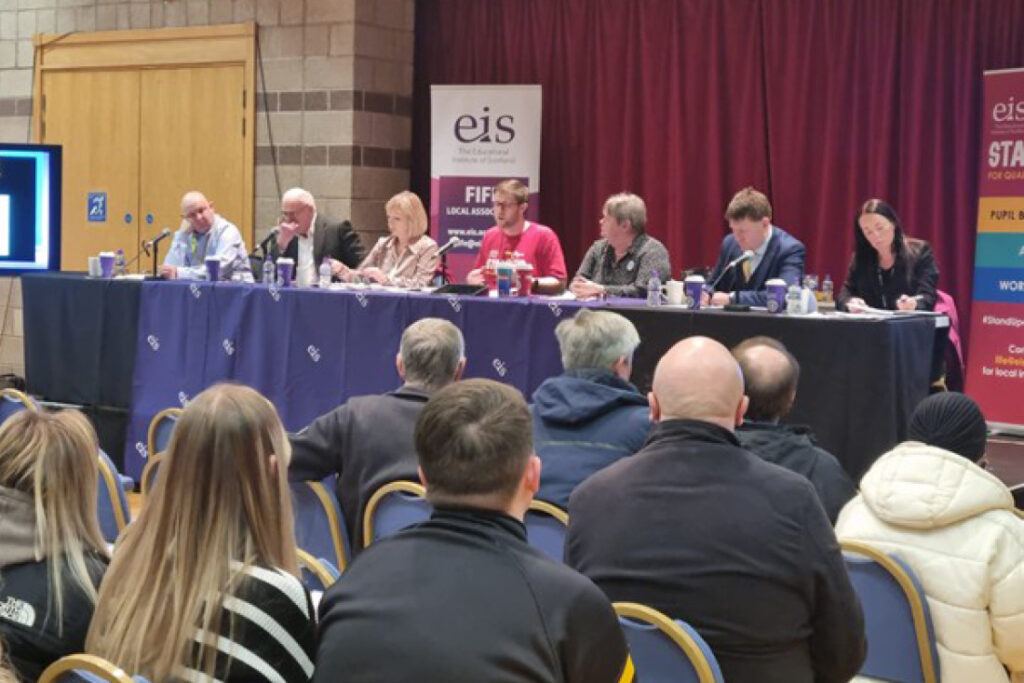
Last year when Fife Council threatened to cut education budgets the local association of the EIS organised a public meeting to question councillors on the issue.
We spent a lot of time advertising the event and contacting parents’ organisations but we were still anxious before the doors opened that anyone would turn up. We needn’t have feared because hundreds of parents and teachers, and a fair few local politicians, turned out.
The meeting was a success. Councillor after councillor pledged to oppose the cuts, and in the end, under severe financial pressure, the Council only passed a very small reduction in education central management budget.
The success of the meeting meant that when Fife Council published similar plans to reduce school spending in 2026/2027, we knew what to do. This time we had an even bigger campaign. We paid for advertising in local media, encouraged teachers to email councillors, and issued daily press releases in the run-up to the 2026 public meeting.
In 2025, at our public meeting, some of the most powerful testimony was from teachers struggling to meet the needs of learners, especially in schools that were banned from photocopying or had few resources and out of date buildings.
And from teachers burntout and exhausted from the scale of the problems and lack of support.
This year we decided to get this data ahead of the public meeting. Around 500 teachers replied to our survey and we shamed local politicians in the media with the results:
- 84% feel their school doesn’t have enough staff to support pupil safety.
- 78% feel their school doesn’t have enough staff to support pupil safety.
- 97% feel their school doesn’t have enough staff to support the needs of all learners.
- Just over a quarter (26%) believed there were enough promoted members of staff to support good order and good leadership.
- Only 12% of staff thought they had enough resources to teach the curriculum from nursery to the end of S3.
- 86% regularly had to spend their own money buying resources for the classroom.
- 57% were unable to photocopy enough resources for learners due to school budget cuts.
- 55% felt their school building was unsuitable for the kind of education necessary in the 21st Century.
- 48% regularly had to complete the work of admin staff.
- 15% responded that their school had enough money for staff training and development.
- Only 4.5% of teachers thought they had enough trained staff to support pupils with mental health issues.
Some of the comments from members surveyed were upsetting to read, even if they weren’t unexpected:
“…damages to building caused by students who don’t have breakout areas or enough space in school to go to due to increased numbers of pupils with challenging behaviours. The budget is being spent on these repairs and leave no budget for anything else.
“No budget left impacting on life skills and learning outside the school. No budget to employ more staff for the challenging pupils sent to our school and increase of sickness levels and no staff to cover them increasing the pressure on everyone else. Building not fit for purpose. No space for teacher to do NCCT due to room being used for challenging pupil as no other space to put them.
“Former staff room turned into a classroom with staffroom now a small area with no sink in it. Low levels of support staff mean challenging behaviour pupils are priority and other pupil learning activities poor as not enough staff to support them with their learning.”
“The cuts are impacting on my time, my mental health, my ability to deliver the best high quality lessons. They impact my finances due to the frequent purchasing of simple resources. The cuts leave me overworked and exhausted and I am unable to switch off and enjoy holidays without feeling guilty that I am not spending extra time to catch up.”
“I have a P1 class with very little support. If a child has a toilet accident I have to stop learning and deal with finding staff to help. If children come to school unregulated I need to support their mental wellbeing but there is only one of me and after 23 years of teaching, it is the toughest I have seen it for the children.
“For the first time in my career, a job I love, I don’t think I will manage more years like this. The children are missing out on adult child interactions. It’s very sad. In schools where families are struggling, children need more from us. They are short changed. A lack of support to help with learning, for children who struggle to work independently, it is a depressing situation in our Fife schools.”
“We’ve been asked to limit photocopying. We don’t have enough text books, reading books and many are falling apart. Our school is falling apart with 7 leaks the last time it rained. Lots of walls have cracks with dust a big problem. Some walls have fungus and mould.
“Classes are near maximum with many additional support needs and not enough staff. Due to lack of support staff in class I have to deal with swearing and violence from children with additional support needs/ social emotional behaviour issues on a daily basis. If budgets continue to be cut I will be leaving teaching. I’ve been teaching for 18 years.”
As a result of the publicity, and the memory of the grilling that they got from members of the public at the previous year’s public meeting, councillors published a budget plan which not only ruled out cuts but actually slightly increased the education spend next year. We quickly pivoted from an anti-cuts agenda for the public meeting to an agenda of seeking real investment in Fife schools and nurseries.
It was easy to make a case that we needed vastly more investment because of the survey that teachers had completed and because we had studied investment per pupil, by local council across Scotland. These figures are available on a Scottish Government website and they show Fife as one of the poorest investors in education of Scotland’s 32 local authorities.
Parents and teachers at the public meeting were keen to know where all the money went in Fife and why they invested so poorly in their schools.
There were other important points shared on the night. Parents spoke movingly with examples of how pupils weren’t safe in schools, and how they weren’t offered full-time provision if they had complex additional support needs.
The public also wanted to know how the chief executive of the council could be afforded a salary of more than £200,000 per year when teachers didn’t have enough jotters to teach handwriting. Parents pleaded with councillors to fund schools properly and to direct funding to the core business of keeping pupils safe and achieving, rather than spending funds on much-trumpeted initiatives like swimming lessons and one-to-one ipads.
There’s much more to do to win proper funding for our schools. We need to properly consolidate the links we’ve made with parents and parent councils, and we need to specify exactly what investment we want to councillors and council officers. And even if we forced Fife Council to bring spending into line with other councils we’d still need more funding from national government.
But we’ve made our voice heard and local councillors have pledged to hear teachers properly and earlier in the budget-setting process next year.
Andrea Bradley, the EIS General Secretary tried to sound a note of hope at the end of the public meeting: “If we invest properly now, our hope for a stronger future for Scotland and all of its communities, including in Fife, will not be misplaced.
“We have evidence from the Institute for Public Policy Research, Scotland which underscores this. They recently commented on the findings of research that the EIS commissioned into a possible ‘spend to save’ argument in respect of Education: class sizes being capped at 20; class contact time reduced to 20 hours per week; teacher numbers restored in Early Education; significantly enhanced ASN provision; and free school meals for all pupils from Primary 1 to S6.”
IPPR, Scotland said: “Costs IPPR has estimated for implementing these policies are not insignificant, but international evidence suggests it is highly plausible that these would be outweighed by the benefits.’
In a nutshell- spend on Education to save across multiple services otherwise in the future.
“We believe there’s a very high human, social and economic cost of ignoring that wisdom, so we urge our politicians locally and nationally not to ignore that wisdom but instead to do right by children, young people, families and communities, and all of us by increasing and protecting investment in Education.
Graeme Keir, Fife Local Association